Wednesday, March 12, 2014

Short-selling Community Destination Marketing Returns

The City Council in Durham, North Carolina where I live has been wrestling with the idea of a 1% set-aside of property tax revenues to fund parks, something another council briefly tried to do to fund the arts back in the 1990s.

I had a front-row view of the struggle elected officials have with ear-marking during my now-concluded, four-decade, three-city career in community visitor-centric economic development, a function which is funded by earmarking a special tax assessed on visitors.

I find it interesting that most local officials seem to have mastered the idea of providing incentives for supply-driven economic development projects, even if only on the back end when the project is assured and increases in property taxes likely.

But when it comes to funding meant to fuel demand-driven, visitor-centric economic development, they seemingly try to siphon as much as possible away on the front end, essentially robbing their communities of 4 to 6 times the revenue they would generated if used as intended.

Like many, at first I thought the resistance to earmarking was about power based on the rhetoric of a few.  But more and more I came to realize that it is more often due more to a failure to think strategically.

Not because local elected officials can’t think strategically.  Most actually do.

But they are trapped in organizations where strategy-making is “inside-out.”  By that, I mean it is focused almost entirely on dividing up how resources are spent, with only the most general understanding of what drives revenues beyond merely voting to raise the tax rate from time to time.

Many businesses are similarly trapped in “bean-counting” cultures.  A great book that explains this and a much more effective alternative is entitled, Strategy from the Outside In.

Coincidentally, it happens to have been co-authored by Dr. Christine Moorman of The Fuqua School of Business here at Duke University, one of the very best.

The way visitor-centric economic development is supposed to work is revenue-based strategy-making.  A special tax on visitors is assessed and earmarked for the purpose of community marketing to attract and serve visitors. 

Local government then reaps a return of 6-to-1 in revenues from these visitors, mostly in the form of the portion of sales tax revenues that are returned to the City and County for general use.

Even if the return is restricted to only the ratio reaped from specific marketing efforts specifically and not from what it is able to spearhead overall, the return is 4.5-to-1, using Durham as an example because it is driven by analytics.

Yet even here, officials have always siphoned half of the funds up front before they could be put to work, effectively, in today’s dollars, trading $20 to $26 million for only $4.4 million up front.

This is the result of being resource rather than revenue focused as nearly all local governments are, more adept at dividing up the pie vs. growing the pie.

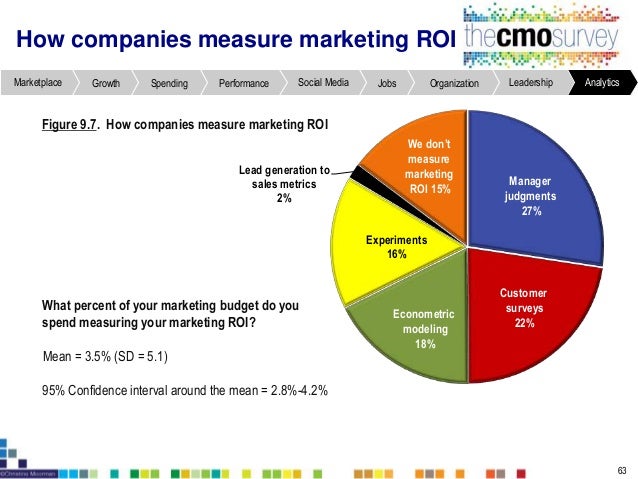
At Fuqua, Professor Moorman also directs the insight-laden CMO Survey, in partnership with the American Marketing Association and McKinsey & CompanyClick here to view the results of this year’s survey in slideshare.

There are always some interesting findings to glean from the survey, such as the portion of a marketing budget devoted to research is now benchmarked at 12%, about double what even data-driven community destination marketing organizations (DMO) such as Durham’s devote.

There is also some good information that could be used to help calibrate community destination marketing to a achieve a fuller share of visitor-related community tax revenues from the tourism sector, the way an individual business or corporation would.

From the survey, the percentage of overall revenues invested back into marketing to fuel more, varies depending on business to business or business to consumer activities (5.8% to 11%,) both of which are integral to community marketing to achieve demand-driven economic development.

Using this approach, the amount a community such as Durham would reinvest in community destination marketing should be 6.6%.

The percentage of marketing if Durham was a business with $842.4 million in sales from visitors varies depending on whether the markets are business to business or business to consumer, Durham marketing is a mix.

Using the formula of 6.6% the amount reinvested in community destination marketing to optimize the growth of local tax revenues back to Durham should be between $18 and $55 million, compared to the $2.9 million it does now.

The smaller amount is calibrated to a percentage of sales restricted to only what its marketing agency drives directly.  The larger amount is expanded to take into account the amount of sales it spearheads (spending by Durham visitors only in Durham, not coming to and from.)

Instead of $40 million, local governments here would reap $81 and $330 million to help fund not only tourism-related improvements but many other local government services.

This is what can happen when local government strategy-making is as much about optimizing revenues as how to divide them up.  It is also reliant on having a metrics-based, data-driven, best practice, highly accredited, leading-edge and sense-of-place driven community destination marketing agency as Durham does.

If your community doesn’t or you’re not sure, that is where to start.  A good indication there is a problem is if your local community marketing agency is hooked on subsidizing events or facilities or both rather than fueling revenues from which such needs can be addressed.

A preliminary analysis from a report that will be jointly published later this year by the IBM Institute for Business Value and the Economist Intelligence Unit asks the question whether marketers are leading and innovating or following.

Only 20% of the CMO’s surveyed were focused on “ROI accountability” as Durham's marketing agency is so the problem of being resource vs. revenue focused is not unique to local governments.

The more frequent Duke survey of CMOs finds that astonishingly 15% don’t measure marketing ROI at all and 27% go by “manager judgments” (another word for flying by the seat of the pants.)

It isn’t just local governments that can be trapped in “inside-out” strategy-making.

Tuesday, March 11, 2014

The Who, How and How Many of Book Readers

When they hear that I spend five or six hours a day, on average, researching and writing essays since I retired going on five years ago, people usually ask me how many books I read now.

I read about two dozen on average a year, all but one or two on a combination of tablet, smartphone and desktop.

A Pew study released a few week ago finds that 3-in-4 American adults read at least one book a year.  The ratio reading e-books has risen to nearly 1-in-3.

Just since I retired, the the percentage of American adults with either a tablet or e-reader has risen to 50%, up from 3% who owned tablets and 4% who owned dedicated e-readers at this point in 2010.

Among American adults who read at least one book a year this includes 69% of males compared to 82% of females, and nearly 8-in-10 Millennials (ages 18-39,) nearly half of whom read an e-book compared to 17% of my generation.

There is little variation among those who live in rural, suburban or urban communities although print readers skew slightly rural and e-book readers skew slightly suburban.

Of those who read books in a given year, only 5% said they read an e-book without also reading a print book.

The median (midpoint) for number of books read by American adults is 5, in other words half of adults read more than 5 books and half read fewer putting me well above the midpoint.

This is not significantly different however than previous years.  Of more concern to me are the 1-in-4 American adults who don’t read a book at all in any given year including 1-in-3 men and far too many elected to high office.

My adopted home of Durham, North Carolina is less than 10,000 people shy of the 250,000 person mark needed to qualify for the annual ranking of America’s most literate cities conducted by Dr. John W. Miller at Central Connecticut State University but when it does my bet is it will rank in the top 15.

The ranking indexes six indicators: number of bookstores, educational attainment, internet resources, library resources, periodical publishing resources and newspaper circulation.  Of the others in the South, eight of thirteen are above the median.

The index is useful for setting community goals and for spotting areas of vulnerability.  The measures are key to upward mobility and overall community vitality.

This, I believe, is what bell hooks (a pen name she doesn’t capitalize) meant in her book, Rock My Soul when she wrote, “One of the most subversive institutions in the U.S. is the public library.”

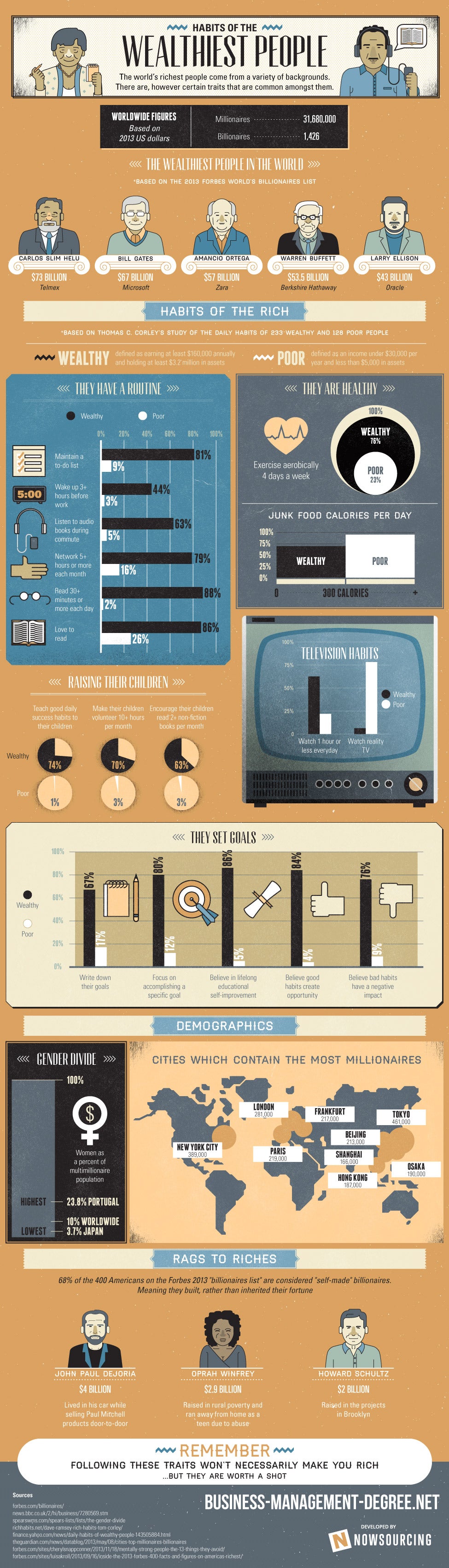
Of equal concern to me however is a study showing that only 2% of those in poverty read at least 30 minutes a day, compared to 88% of those who are wealthy.

Only 1-in-4 Americans in poverty have a passion for reading, compared to nearly 9-in-10 who are wealthy.  If we’re not worried about the adults, if we are going to break the cycle of poverty, we need to worry about the children born into poverty.

From my own experience, love of reading starts at home.

Monday, March 10, 2014

A Long View of Disposable vs. Recyclable

A few weeks ago, during a brief visit with family in the Pacific Northwest, my brother-in-law showed me a fascinating 1937 Sears, Roebuck and Co. catalogue he had purchased at a benefit.

According to a new study of the near term changes in retailing produced by IBM and the NYU Stern School of Business, Sears, along with Montgomery Ward and J.C. Penny, used books such as these in the early 1900s to create modern retailing.

Fragmentation in retailing began in 1975 and by the year 2000, consumers took increasing control.  By 2020, the already $1.3 trillion Millennial market will be fully in charge.

A benchmark report by Retail Systems Research released last month notes that 60% of “product selection” now occurs before shoppers leave home.  Mobile influences will skyrocket from 50% of purchases today to 75% in three years.

But the report also predicts that mobile use will eventually become the “glue that ties the physical and digital shopping experiences together.”

This is because, the report notes, “People like to shop.  Shopping is entertaining and fun.”  Retailers that will thrive are those that integrate mobile into that in-store experience as well as use it to empower employees.

But digital isn’t the only condition that will revolutionize retail. 

The IBM-NYU report notes one huge condition that will impact communities is that physical retail space doubled between 1980 and 2010, far faster than warranted by retail sales.

Contraction of that space is accelerating, while much of what will be slower growth in retail sales overall will be online.

Empty retail space flooding back on the market will make it even harder for traditional “brick and mortar” retailers, especially independent, locally owned stores so crucial to quality of life and distinguishing community sense-of-place.

We’ve already heard analysts call for retail giant Wal-Mart to close 100 of its stores as the company moves to smaller footprints half as big in urban stores as noted in this article by a friend, Ed McMahon, who holds the Charles Fraser Chair for Sustainable Development and Environmental Policy at the Urban Land Institute.

According to ULI, there is now more than 1 billion square feet of vacant retail space in America, (mostly in empty big box stores,) largely because the developer-driven churn expanded retail space 5 to 6 times faster than growth in retail sales.

Local governments who haven’t already are well advised to start thinking strategically about how to help locally-owned retailers survive while surviving the upheaval in property values vacant retail space will create.  It begins by stopping the insidious practice of subsidizing developers that cater to chains.

The contraction of physical retail space won’t be pretty and the consequences of years of developer-enabled churn will collapse back on communities, neighborhoods and residents.  On the bright side, much of this space is disposable.  The buildings weren’t made to last anyway, compared to historic structures undergoing adaptive re-use.

As noted in the book entitled Retrofitting Suburbia: Urban Design Solutions for Redesigning Suburbs, by Ellen Dunham-Jones and June Williamson, professors respectively at Georgia Tech and City College of New York, communities are being left with millions of acres of “underperforming asphalt” including dead or dying strip malls. 

This may also be an opportunity for communities to greatly expand the ratio of open space and green infrastructure such as urban forest, reminiscent of the early 1800s when so much farmland was vacated in the east as people migrated westward.

It is also an opportunity for communities to become more sustainable, replacing retail innovations such as the disposable economy which  began in the mid-1800s with paper shirt fronts and cheap watches according to a fascinating book by Giles Slade entitled Made to Break: Technology and Obsolescence in America.

This occurred about the time Singer and McCormick began “branding” products.  The advertising industry was born to sow the seeds of consumer dissatisfaction and by the turn of the century, retailers were incorporating the ideas of obsolescence and disposableness into products.

By 1920, for instance, “55% of American families - nearly every family that could afford a car – already owned one.”  So General Motors innovated the “new model year” with incremental and mostly superficial changes.

Retailers had even used disposable products to undermine calls for frugality to aid the war effort during WWI but by WWII, the ethic of recycling took its first toehold among consumers.

Following WWII, buildings, too, were built on the “cheap,” purposely designed not to last or to ultimately be repurposed as earlier buildings have been but to be cookie-cutter and generic and to be torn down and replaced.  This purposeful churn has induced sprawl, and in many places, all but extinguished sense of place.

Today, public opinion polls in the United States show that 82% of Americans “feel a sense of pride” when they recycle and the feeling extends to historic preservation and adaptive reuse of those buildings not built to be disposable.

Troubling is that according to Harris Interactive this feeling is lower among men and younger generations.  But overall, the ratio of those who feel strongly about this sense of pride in recycling is 5.5-to-1 positive.

More than 6-in-10 Americans feel a sense of guilt when they don’t.

Today, 3-in-4 Americans make an extra effort to recycle outside of their homes with 58% doing so at work, 22% as they walk along city streets and only 16% when they dine out.

Only 22% do so when they are traveling, where airports, train and bus stations, as well as hotel rooms, lag far behind in making recycling convenient.   A few hotels now have two in-room waste receptacles with one green for recyclables.

Seattle-Tacoma International Airport is a best practice example of how to make recycling easy in airports and other public transportation facilities.  Nearly half of all travelers never or rarely make an effort to recycle.

Harris surveyed only adults, but another area of disconnect for recycling outside the home is in public and private schools.  All of this is to say that communities engaged only in getting residents to recycle curbside are missing many other areas in which they should be concerned.

Another huge loophole are apartment complexes and their renters.

Something confirmed in studies of littering is that 54% will trash a recyclable if a recycling bin is not nearby and 17% will throw it on the ground from where it eventually threatens water supplies.  This percentage is significantly higher in the South.

Significantly, nearly half of Americans now think explicitly about disposal when they look at buying something.  That percentage falls to 41% in the South, though.

Most troubling is that a full third of adults in the South make no extra effort to recycle, according to an enlightening book published last year entitled, The New Mind of the South, by reporter and essayist Tracy Thompson.

Noting that individual rights—including property rights—are a central American value, the book concludes that in the South we take them to an extreme, blinding us to the rights of groups such as those seeking the right to have clean air and water and scenic beauty.

This often lies at the heart of struggles that seemingly make no sense, such as reactionary legislation in my state seeking to make North Carolina known for huge, mega-landfills and desecration of roadsides as well as the state’s reputation for scenic beauty..

I assume this same mentality will argue against sustainability and in favor of disposable consumerism and developer churn as well as urban forests and green infrastructure.

I suspect some will respond to the strategic issues in this blog with “good, we don’t need quality of life and sense of place anyway.”

We’ve got a ways to go.

Thursday, March 06, 2014

Seems Like Yesterday

My first visit to Durham, North Carolina was twenty-five years ago this month for my final interview before being selected to head the formation of the community’s first community destination marketing agency as a means of fueling visitor-centric economic and cultural development.

I retired going on five years ago, but Durham is still my home.

This month is also the 25th anniversary of the launch of the Internet for general use, something that a new Pew study, released a week ago, shows is considered a good thing personally by 90% of Americans and by 76%, a good thing for society.

Eighty-seven percent of American adults now use the Internet.  Sixty-eight percent connect to it with mobile devices such as smartphones and tablets.  But a stubborn 17% of Americans still insist that old fashioned, tethered land lines will be very hard or impossible to give up.

More telling is that only a third of Americans now say the same thing about television.

The timing of my arrival in Durham and the availability of the Internet for commercial use was fortuitous.  As a co-worker once said, “we hit fast-forward without saying goodbye to yesterday.”

I took that to refer to the fact that we adopted the latest office productivity technology including a local area network of desktops and inter-office emails.  Yes, that was in 1989 when less than 4-in-10 Americans used computers.

Within a few years, we began using the Internet for marketing Durham, when more than two-thirds of the population had still never heard of the Internet or were only vaguely aware (21%.)

Back then, with only 14% of Americans using the Internet, it was considered a strategic risk, as any good strategy-making is.

At the same time, we made Durham’s unique sense of place and what we would later call place-based assets, including Durham’s inherent nature of “genuine, authentic and diverse,” our keystone strategy.

By the time our more established competitors caught on to the former we had leapfrogged nearly all of them but what really made that edge sustainable for Durham was that only one other would ever seize on the latter.

Of course, there were other decisions that proved fortuitous as well, such as spearheading a grass-roots effort to reclaim Durham’s story and reverse a negative image stubbornly embedded among residents of nearby communities.

Marketing a community is 1/3rd hurdling barriers and 2/3rds lowering barriers, reversing image was part of the latter.  No amount of investment in the promotional third (hurdling barriers,) can overcome the other two-thirds (lowering barriers) alone.

I often get asked how we made those decisions.  The easy answer is that I had already cut my teeth on various aspects in a previous communities including one that was data driven.

There are several other more complicated variables, but one important one is that I answered to an unusually diverse governing board made up of movers and shakers not only in business but in community and neighborhood-making.

They enabled and entrusted us to take those approaches that then seemed novel and now seem so safe.

Of course, I continued to evolve and even with nearly two decades of management experience by then, including a decade and a half as CEO, I still had a lot of evolving to do.

A lot of it was timing, much of it was luck and a good deal of it was a forgiving community that allowed me to make and recover from mistakes.  A place that believed in me, stood up for me and taught me the importance of place.

Anything we accomplished has been greatly transcended by those still spearheading the marketing of Durham because they grasp Durham’s story and because they benefit from that uniquely balanced governing board.

Twenty-five years ago seems like yesterday, hell, 60 years ago seems like yesterday.

Wednesday, March 05, 2014

Channeling More Recyclables Into The Circular Economy

With the exception of the footprint of my house and five strips of lawn for accent, 83% of my .3 acre lot on a forested ridge two miles from Durham, North Carolina’s city center is natural area.

However, this doesn’t mean it requires less upkeep.

We share this space with a grove of 100+ trees, a combination of mature hardwoods and pines, with about another 100 understory trees, shrubs and bushes.  Each year at this time, about 3 tons of leaves, needles and cones are scooped up from the 86% that is not densely ivy covered and taken for composting.

This is followed by redistribution of about 8 to 9 tons of fresh hardwood mulch.  I love working this landscape but I obviously leave a task of this magnitude to professionals.  It is my contribution to Durham’s urban forest.

I wish my community’s yard waste was composted but it is hauled several miles away northwest to another county where a company converts it into enzymes.  There are more progressive communities in this area such as Goldsboro, which is about 78 miles southeast, that do this kind of composting.

There, about about 9 dry tons a day is fed into a biosolids composting facility where after 30 days followed by 40 days of curing time, the output is screened in two sizes of mulch.

Some is sold to landscapers and golf courses with the remainder resold by garden centers as well as used in parks.

After visiting this facility in 2004, Mont-de-Marsan, a similar-size community in southwest France, built a similar facility that processes five times more or about 48 tons per day.  I hope Durham officials paid a visit as they hoped when I brought Goldsboro’s facility to their attention.

According to this EPA fact sheet that describes the process, it includes yard waste, wastewater solids, residential and commercial food scraps and agricultural by-products.  Before the recession, more than 3,500 cities and counties in the US were composting.

A national survey by Harris Interactive released last December found that 7-in-10 Americans are not composting food waste, but two-thirds would if it was more convenient in their community.  A quarter strongly agreed compared to 13% who strongly disagreed.

More telling, among Millennials (ages 18-39,) that proportion increased to 3-in-4 with 8-in-10 saying they would use the resulting products compared to two-thirds of the general population.

Policy-makers should use this generation when planning to recycle food waste.  Even in the South which has the lowest level of composting, 8-in-10 residents understood the importance of recycling food and yard waste, higher than the general population.

Unfortunately, three in five Americans don’t want to pay for it, the result, I believe, of the reluctance of elected officials to link public services with costs over the last four decades, gradually reducing services instead.

In Seattle, a city two and a half times the size of Durham, residents are offered curbside recycling of food scraps, by placing the food scraps in approved paper bags and then in their yard waste cart.

Durham currently has an RFP out on something related, but unlike Durham, Seattle requires this and other types of recycling by apartment dwellers as well.

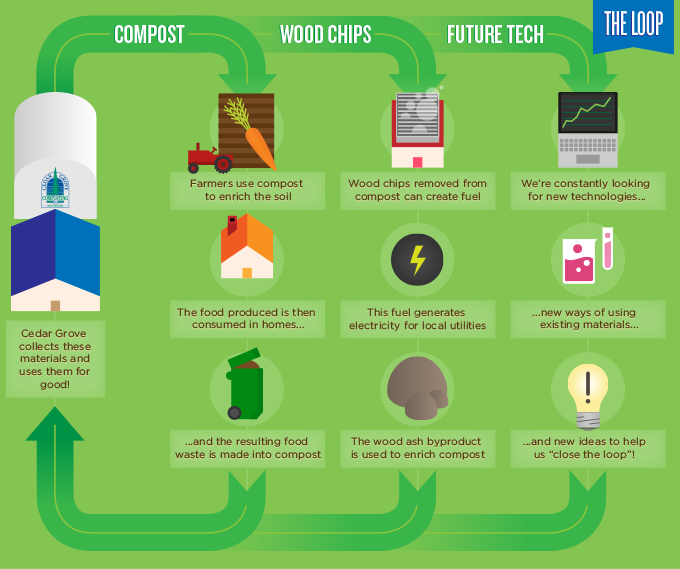
Seattle sends the yard waste and food scraps from curbside and alley collections to two composting facilities operated by Cedar Grove in Everett and Maple Valley which collectively compost 350,000 tons of residential and commercial yard and food waste annually.

Branded, Cedar Grove resells the recycled materials by the bag or in bulk for gardens, potting, top soil, lawn and mulch to farmers, residences, landscapers and other users.

The family-owned business expanded into composting in 2003 and uses the GORE™ Cover System rather than the in-vessel approach used by Goldsboro.

Hopefully, Durham will soon move toward curbside collections of food scraps along with aggressive composting of these items along with yard waste, waste water solids etc.

Based on the Harris survey, Americans increasingly understand the importance of the “circular economy.”