Showing posts sorted by relevance for query graham. Sort by date Show all posts

Monday, August 26, 2013

The Carolina Roots of My Native Rockies

The Appalachian Mountains that divide the eastern part of North America and form the western part of my adopted state of North Carolina, come to an end in Mississippi.

It is there, in the Northern Highlands of that state where the southern tip of the deciduous Flatwoods dissect the rich soil of the Black Prairie from the high rolling hills, amid deep densely wooded ravines and rivers of the Red Clay Hills that my great x 3 grandparents, Tom and Sarah Ann Graham, put down roots in 1825, but not for long.

Thomas Bradford Graham was from Kershaw District, the first inland settlement in South Carolina, along the spine of the Occaneechi Path, a corridor of Native American trading paths stretching from Virginia to Georgia (passing through Durham, North Carolina where I live) along where the fall line breaks between the rolling hills of the Piedmont and the Low Country.

His parents were Scotts-Irish and probably unrelated to the Irish Quakers who followed the road blazed up from Charleston to settle along the Wateree River in Kershaw, after their ship bound for North Carolina was blown off course.

He had migrated over the Appalachians with his family led by grandfathers.  Both were veterans the War of 1812, one with McWillie’s 2nd Regiment in the South Carolina Militia and the other with the 2nd Brigade, 5th Regiment, 1st Company detached from the 1st Orange County Regiment of the North Carolina Militia.

That was when Durham, where I live, was a part of Orange County.  When I relocated here from my native Rockies,  part of me was obviously coming home, preceded here by my great x 4 grandparents Thomas Bradford and Mary Miller and my great x 5 grandfather David Miller, both of whom were natives of this part of North Carolina.

Sarah Ann McCrory was from Tennessee, the daughter of a North Carolina Revolutionary War hero, a veteran of six major engagements.  He had also served for a time at Valley Forge as bodyguard to General George Washington and was briefly taken prisoner-of-war near his son-in-law’s birthplace by Tarleton’s Raiders during the Battle of Camden.

The old soldiers were now stranded across the Alabama line from the young couple.

Tom and Sarah Graham’s new home place near DeKalb was midway between the relatively new settlement of Tuscaloosa and the newly-created town of Jackson, up the ridgeline-trace from Natchez to make the state capital more centrally located.  The land had been recently ceded by the Choctaw Nation.

Eight years before my newlywed ancestors settled there, Mississippi had become a state following the lopping-off of Alabama.  As they settled into their new home, Colonel Davy Crockett had just survived the sinking of his flatboat,across state, on the Mississippi River and was readying his first run for Congress.

Crockett died at the Alamo in 1836, a few years after legends began to evolve such as the one that he - “Kilt him a b'ar when he was only 3.”  But within a decade my ancestors left Mississippi for the Rocky Mountains where my great x 3 grandfather’s true story does involve a bear, but a mammoth Grizzly Bear.

The party which included Tom’s parents and my then three-year-old great-great grandmother Amanda probably crossed Mississippi to the river on the wagon route that is now route 16 or possibly across what became Old Route 80 and is now Interstate 20.

Either way, they would have caught a paddle-steamer up the Mississippi River from Vicksburg or two or three other ports.  They possibly rode the sleek, 60-ton, light draft Maid of Iowa.

It specialized in carrying passengers and cargo past the De Moines rapids to a settlement where Mormon converts were gathering at the time at that part of Illinois across from the little jag where Iowa cuts off a corner of Missouri.

There my ancestors joined one of several trains of wagons heading up the Des Moines River on what was to be the first leg of a 1,400-mile journey west into the Rockies.  The Grahams only made it 36 miles upriver before forced to winter over near Farmington, Iowa where I stopped along a cross-country trip last year.

Tom’s wife Sarah Ann and other relatives died there.  He stayed two years and then he and little Amanda and her brothers and sisters continued west.  As they crossed the Missouri in 1852 near Council Bluffs, they hooked on with a train of 64 wagons and a few hundred others headed west along a route blazed five years earlier by four other of my ancestors.

Tom often carried Amanda on his back as he walked beside their wagon, which by then had switched from horses to oxen, because her feet were bleeding.  They arrived in the valley of the Great Salt Lake in September and settled near along the Rockies at the mouth of Mill Creek Canyon, but again they didn’t stay long.

In 1859, Tom and by then 15-year-old Amanda headed 80 miles further north up into Cache Valley, among the first to settle Fort Mendon snug against the towering Wellsville Mountains.

Located at what was then the best entrance to the valley from near the border with Idaho, Mendon is the oldest continuously inhabited settlement in the valley.  Nine miles east, on the other side of the valley, tight against the Bear River Mountains lies slightly younger Logan, home of Utah State University, where my lawyer-daughter first attended college.

On a cross-country trip in 2011, I crossed the valley at this point on scenic route 30 as I traveled between the Pacific Northwest to connect with I-80 East in Wyoming.

Route 30 highway crosses the “Big Slough” of the Little Bear River just northwest of what would have been Fort Mendon and 20 miles south of where, two years later, my “Bowman” ancestors would settle Richmond and then Hyde Park.

The “Big Slough” holds significance.  My great x 3 grandfather, Tom Graham, left the fort in search of firewood there one day in the fall of 1864.  He was with young A.P. Shumway, Amanda’s husband, when he was, as is well documented by several researchers and authors, attacked and killed by a giant grizzly bear who was itself then hunted and killed.

While A.P. was bringing around the horse-drawn wagon, Tom had exchanged his rifle for an ax and while wading into some willows had stumbled on to the very entrance to the grizzly’s den.  If he saw it coming, Tom’s last view nay have been of a 12 inch long, 8 inch wide paw with huge protruding claws.

A grizzly stands about 6 foot tall and three feet wide and even at 700 lbs. can run 30 miles per hour.  Even though he was reportedly renowned as a bear hunter, he had appeared unarmed where they would be their most fierce and protective.

People in the tiny fort were shook, but none more than A.P. who had discovered Tom’s body.  As is documented, Tom was seen as invincible and described in his early fifties as “a man of prodigious strength and courage…tall, rawboned, with a pair of heavy wide shoulders tapering to a flat slender waistline…”

He would tease folks by taking a rattlesnake by the neck and spitting tobacco juice in its mouth to kill it.  Much like my uncle Louis Davis did from the bumper of his pickup when I was young, Tom could sit eight feet from the door of his log cabin and spit tobacco juice through the latch hole.

As has been true in my family for at least six generations, he was also very good with horses.

None of these feats were a match for a grizzly and Tom’s body was taken back to Salt Lake City for burial.  In my family, we grew up with an appreciation for grizzlies.

Grizzly Bear population declined from 100,000 across North America when Europeans arrived to less than 50,000 when my great x 3 grandfather’s remarkable life came to an end after spanning 2,500 miles of the continent.

The Grizzly population was near extinction by the 1970s when I was in college and became a protected species because of the unique role these bears play in stimulating ecosystem services.

Now through protection, Grizzlies have been coaxed back to 700, nearly all in the Greater Yellowstone Ecosystem where I was born and the conservation challenge is the threat to their food sources and how to limit conflict with humans.

Now in recovery, one of the areas where grizzlies most like to range is again from Yellowstone across into my native Fremont County, Idaho, two hundred miles north of where my great x3 grandfather had that fateful encounter along what I often term the fault line of my youth.

They are drawn across the Targhee by the migration pattern of the 2,000-strong Sand Creek elk herd as it moves back and forth passing near our ancestral ranch traveling from winter feeding grounds along the creek to their home in the Park in spring, summer and fall.

Since the 1880s, this nook of Idaho has been known grizzlies, drawn even more by the distinctive Yellowstone Cutthroat Trout native to the Henry’s Fork River as they are to elk, deer and moose there.

Another 50,000 Grizzlies across Alaska and northwest Canada, 30,000 alone in Alaska where I lived in the 1980s.

I have a feeling that despite his unfortunate encounter, Thomas Bradford Graham would be impressed as I bet will be my grandsons, his great x 5.

Monday, January 25, 2016

The Southern Roots of a Fifth Generation Idahoan

As a fifth-generation Idaho native dating back to its first permanent settlement (other than Native Americans, of course), I didn’t learn of my deep Southern roots until one day in the early 1950s.

When I first remember her telling me about this part of my heritage, I was a preschooler helping my paternal grandmother Adah tend to family graves in the tiny hill-top cemetery, above our ranch house with a view of the Tetons.

It was a bit of “commons” carved into that ancestral ranch stretching for 270 degrees around that hill.  By then my grandparents had turned the place over to my parents when my Dad, their only son, came back from chasing down Nazis as they fled into the Alps.

Because of my insatiable curiosity, my dad gave me the nickname “windy,” but I have long wished that I had asked my grandmother far more questions such as the location of the 12 x 12 homestead shack where she and grandpa first lived.

It was before they moved into the ranch house down below the cemetery where a bend of the road cuts across Snow Creek.  This is where my dad was born and where my parents first brought me and my two sisters home.

I wish I had been more curious about the abandoned house at the end of the meadow where my great-grandparents had lived and ranched and died, leaving it for me as a favorite place to explore and reflect.

I’ve carried the smells of sagebrush, my horse Gypsy, a fresh mown meadow and rain on a dirt road wherever I’ve lived since.

But it would be more than five decades after my grandmother’s revelation before I would find my Carolina roots, both North and South, dating back three hundred years and before the permanent settlement of either.

By 1860 when those roots first crossed up into Idaho Territory, and during their previous twelve years since crossing the Rockies, they had already helped create at least three other settlements including Fort Union and Fort Mendon.

My second great grandmother, Amanda Sarah Graham, had been born in 1843 near DeKalb in Kemper County Mississippi.

Her father Tom famously protected settlements from Grizzly Bears until he was mauled to death by one.  He also was also a farmer, carpenter and butcher, as well as a saw mill operator where he fashioned ox bows and handles for pitchforks, rakes and hoes.

He was heralded for reportedly being able to spit tobacco across his cabin and through a latch hole. 

For much of his life he had also been a third or fourth generation slaveholder.

Only 3% of first generation Mormon settlers were from the South and after crossing the Rockies, Tom freed slaves by the names of Isaac Green Flake, Aunt Hannah and Robert.

He set them up with land of their own outside Fort Union (rendered in the image above), at the mouth of Little Cottonwood Canyon, named not for the land of cotton but for a type of poplar tree long-common along streams even in the arid west.

Cottonwoods later became known as “Mormon trees” because they mark where settlements were created along the Meridian of my DNA, stretching from the Salt River to my native Henry’s Fork.

Fort Union was in a ravine down the canyon from where Alta and Snowbird ski resorts are today.

Leaving instructions for his children to help their former slaves with the transition to freedom whenever asked, my Southerner third great grandfather headed further north along the Rockies.

During the migration west, Tom’s wife, my third great grandmother Sarah Ann, had died along the journey during childbirth near what became Winterset, Iowa two years later and now known for the Bridges of Madison County and as the birthplace of actor John Wayne.

My Graham great (3) grandparents had once owned plantations along both sides of the Tombigbee River.

The first was on three parcels above the Sipsey River, a free-flowing Alabama swamp, 50,000 acres of wetland Cypress, Cottonwood, Hardwood and Pine forests.

Today, this area is known for canoe and hiking trails, as well as game and tree preserves, but in the 1830s it was settled by all sides of Tom and Sarah Ann’s families including the Grahams, Bradfords, McCrorys and Gilmores.

They had fought, at times side by side in the same regiment, during the Revolutionary War and Tom’s father in the War of 1812, as well.

The McCrory’s who were Scotts-Irish immigrants, left North Carolina for Tennessee after the Revolutionary War with Andrew Jackson, a family friend.

Near Nashville is where my great (3) grandmother Sarah Ann was born.

Her soon-to-be husband Tom was born in the Kershaw District of South Carolina but my fifth great grandmother was at least second generation North Carolinian on both sides.  Still they are not my earliest roots from here.

McCrory’s then migrated to western Alabama, probably down a military road through Mudtown, now Birmingham, while the Grahams and Bradfords preceded them by a few years, probably migrating down through what is now Greenville and Athens around the southern Appalachians and across through Mudtown.

There is no evidence that McCrorys ever held slaves but both my Graham and Bradford ancestors did generations before.

These migrations from the Carolinas were motivated by more than wanderlust.  One reason was the political tensions following the Revolutionary War.

Even victorious, my patriot southern ancestors were in the minority.

A majority of North Carolinians and even more South Carolinians were either ambivalent about the Revolution or loyalists to the British Crown, known as “conservatives” following the war.  They wanted a return to those values.

Another reason for their migration was soil depletion in the upper South.  Landowners, especially plantations, viewed the soil back then as something to be cleared and planted in staple crops such as cotton, tobacco and even corn and wheat, until no longer useful.

Slavery and public land policies made it cheaper to move on to new lands than to manure and rehabilitate depleted soils.

Rare today in the Carolinas are clear waterways such as Mayo Lake where we have a place.  Even here, when rains come after upstream harvests the “sheet” erosion overwhelms the ability of wetlands to filter the runoff, resulting in a temporary turbid invasion.

Southeasterners, especially it seems elected officials, who dismiss or undermine water quality standards have come to believe the waters in North Carolina are naturally muddy.

But southern soil historians such as Dr. Paul Sutter note that “a little more than a century of cotton culture…transformed the ecology, hydrology, and geomorphology of southern watershed in way that may last for thousands of years.”

On April 6, 1842, my third great grandparents Graham along with Tom’s mother, Jane, followed Mormon missionaries down into the Sipsey River to be baptized into the 12-year old, distinctly American restorationist Christian church.

In early 1846, after briefly owning plantations across the Tombigbee in Mississippi, the Grahams and their young daughter, Amanda Sarah, along with her older siblings and their three slaves loaded up wagons and headed cross state and up the Mississippi River past Saint Louis to where Mormons were already fleeing west.

Tom went ahead after his wife died crossing Iowa and then returned to bring his children across the Plains and over the Rockies.

When she crossed over the Rockies, my second great grandmother, Amanda Sarah, was about the age I was when my grandmother revealed my southern roots that day while tending graves in sight of the Tetons.

It was also the age my grandmother had been when she had briefly lived with and cared for her grandmother Amanda following a Trolley accident during a visit from Idaho to Salt Lake.

When I travel through these places of my roots and along the routes my ancestors took, I don’t romanticize as much as it probably seems to some readers.

I leave the traces in this blog as testimony to descendants through my two grandsons that the values found in our gene pool are complex and varied - a merger of many different backgrounds.

I often wonder, when judging my slaveholding Southern ancestors what we may hold common today that will be similarly revolting through the lens of future generations.

I suspect they will look back at our short-sighted “utility” economy and the havoc it is wreaking for future generations with similar disgust.

On a future visit, I plan to take my grandsons to visit the grave of Isaac Green Flake, one of the slaves freed by my southern ancestors, who was also from North Carolina, where I have lived for nearly three decades now.

Mr. Green Flake. who also elected to be baptized Mormon before the trek west, was born in eastern Anson County, North Carolina just east of Charlotte and just north of where my third great grandfather Tom was born in South Carolina in 1807.

But when their parents were born, there had been no such distinction between the Carolinas.

After Mr. Flake was given his freedom and land of his own, he worked for a time as a carriage driver for Brigham Young before also heading up into southeastern Idaho where his son had homesteaded Grays Lake near the mountains east of Blackfoot.

He also stayed in touch with the children of my Southern ancestors.

But he asked to be buried down at the old Fort Union cemetery in the shadow of the mountains he had crossed 60 years earlier and where he at last had become free.

Monday, February 23, 2015

How Misinformation Becomes Worldview

I was stunned recently to hear two friends say (independently) that they believe groups like ISIS are representative of the views of Muslims in general.  But then, soon after, came the results of a Lifeway Research poll showing that 27% of Americans hold that view.

This includes nearly a third of men and half of evangelical pastors.  Fortunately, 43% of Americans including more than half of those between the ages of 18 and 34, grasp that “true Islam creates a peaceful society.”

It is a view held by only 23% of evangelical pastors, a fact made apparent when Franklin Graham, the son of Billy Graham, bullied Duke officials into calling off a plan for Muslin students use the otherwise ecumenical Duke Chapel for a call to prayer.

Is it just me or do some apples fall far,far from the tree?

The supposed rationale was because extremist Muslims persecute Christians, therefore we should retract our values, forgetting that extremist Puritans killed early Quakers here when the paint wasn’t even dry yet on the first settlements by Europeans.

It brought to mind the phrase, “God is great, beer is good and people are crazy!” (coined by country songwriter Troy Jones while thinking of three things most people wouldn’t argue with.)

On our quick trip back to the Pacific Northwest a week ago I was equally puzzled to hear one of my two sisters, while expressing joy that one of her preschool grandchildren already knows the pledge of allegiance, followed it with the qualifier, “especially now that it is prohibited in schools.”

I had to bite my tongue to keep from blurting, “Where did you ever get that idea?” But I already knew the answer.

I don’t believe that either of those viewpoints is remotely factual, but I shouldn’t have been so surprised.  During the last half of my now concluded four-decade career in community destination marketing, I became a student of how misinformation diffuses through populations.

Because negative or misinformation is so much more powerful that positive or factual information, this may be the most overlooked understanding in that profession.

My introduction, though, was in my early 20s while writing up some research I had conducted for an upper level folklore class at BYU, which documented how misinformation spreads through a society and begins to even contaminate news stories and public policy.

The research dealt with the propensity of people to take bits of information and project them to extreme conclusions.  To adapt words by Bill Moyer, this “harmonizes or re-harmonizes our lives from time to time” with our stories.

Often, as in the case of my research on some events that occurred in 1970, this can lead people to “inversed projection,” where people subconsciously rationalize a contradiction to their life view by painting themselves as the victim.

Thus, a few states giving schools and students the option for daily recitation of the pledge of allegiance becomes “prohibiting the pledge of allegiance.”

It is also how protecting a person’s religious freedom to skip repeating the words “under God” becomes rearticulated as taking religion out of schools, even though those words were not even added to the pledge until 1954, more than 60 years after it was written.

Forcing a minority (8%) to repeat those words is rationalized as somehow protecting religion, even though revered U.S. Presidents such as George Washington, Thomas Jefferson and Abraham Lincoln preferred “Creator” to the word God.

From a community marketing standpoint, a clear understanding of information diffusion includes knowing where and when to interrupt feedback loops of misinformation, much as “deep brain stimulation implants” are used to interrupt tremors that cause feedback loops in people.

On our trip last week, I noticed how RDU International Airport is still enabling misinformation about the region of North Carolina where we live.

Even though the airport is located in Morrisville, midway between the destination co-owners of Durham and Raleigh, two distinct cities and metro areas that co-anchor a polycentric region, airport tenants are still being allowed to misinform the vast majority of travelers through the airport by suggesting the airport is in Raleigh.

Hertz shuttle buses are emblazoned Raleigh, the Starbucks shop offers only “Raleigh” mugs across from the newsstand that offers only Raleigh t-shirts.  Airline personnel on arrival and departure invariably use Raleigh repeatedly in announcements.

This will only be corrected when a critical mass of Raleigh officials, community leaders and airport authority members, as well as airport staff, speak up against the inequity and misinformation.

It is a true test of regionalism as a family of distinct communities that each has the other’s back.  Otherwise, regionalism is nothing more than a euphemism hegemony.

Until then, the airport is a huge enabler for diffusion of misinformation about this area, undermining visitor promotion, inconveniencing visitors, contributing to unnecessary commutes, misleading news editors, mischaracterizing geography and fostering favoritism.

The hyphenated name alone is cause enough for confusion as it was for a Jeopardy game show contestant last Thursday:

Question: This hyphenated city in North Carolina is home to Wake Forest University.
Answer: What is Raleigh-Durham?
WRONG! (Winston-Salem, the correct answer is the name of a hyphenated city.)

Raleigh-Durham is simply the name of a co-owned airport.  But it illustrates how misinformation can leap into mainstream use if not addressed.

Long ago, community marketing organizations and chambers of commerce through this vast polycentric area agreed on how airport tenants should brand RDU and the communities it serves but when presented to airport management it was vetoed along with a snide notation toward me that I wasn’t supposed to see.

As co-owners, Durham elected bodies and municipal management could easily demand that this be corrected, but they haven’t despite being nudged repeatedly by residents as influential as the late Dr. John Hope Franklin, nor have the Durham appointees to the airport authority.

Even under new management, misrepresentation of the airport and the region persists.  Fortunately, a small fraction of visitors to any community travel by air and this holds true for the dozens of communities served by RDU.

Even the majority of business travelers arrive via highway or rail.  But RDU’s complacency regarding tenant mischaracterization does impact an average of 26,000 people each day, half of whom are baffled and half of whom are either angry or oblivious.

Is it possible that Raleigh advocates are doing more than endorsing the misinformation by their silence?

Is it possible they otherwise consciously or unconsciously endorse the misinformation as a way to harmonize with their centric world view?  Unconsciously, are they rationalizing it by inversely projecting themselves somehow as being the victim?

Is the answer one that would enlighten us all as to why so many of us tolerate bigotry of other kinds, either by avoidance as Durham officials are doing with misrepresentation at the airport or passive-aggressiveness as Raleigh officials appear to do?

It makes me wonder, is mass deep brain stimulation the only option?

Wednesday, December 10, 2014

Mesmerized By A Storytelling Image In Uncle Albert’s Store

One of my earliest influences for my career may have come from gazing at old posters in my Uncle Albert’s sporting goods store on visits to St. Anthony, population 2,700 and the “big city” in Fremont County, Idaho, back when I was coming up.

It was an image I had first found on an old tin in a landfill not far from an abandoned house about 14 miles upriver on our ancestral ranch that had belonged to my great-grandparents that first tweaked my interest.

In those days, my friends and I would self-identify with brands but not just those such as the HB branding irons used on our ranch.

We tended to affiliate with either Farmall or John Deere, Winchester or Remington, Percheron or Belgian, Ford or Chevy, Yankees or Dodgers, cow-pie-kickers or potato-heads (smile) and when re-enacting the Civil War, either Blue or Gray.

My preferences were Farmall, Winchester, Belgian, Ford, Yankees (baseball,) Pie-kicker (rancher,) and Blue because, well, they were familial preferences, except when my renegade dad was an outlier, e.g. De Soto and Oliver.

One particular image, the one I found in that land fill and then saw hanging near the entrance to the back room in my uncle’s store came back to me recently when I saw a logo on a made-to-look old and weathered label hung from the button on a made-to-look worn shirt.Remington Poster The Right of Way

The illustration, entitled “Right of Way” had significance to me because my great (x3) grandfather Graham had been killed by a Grizzly Bear in 1864 when he was 57 years old.

Shown in the image in this blog, it was created for Remington which is signified not only by the logo but because that is a Model 8 rifle in the hand of the figure shown.

The image was one of many created during the golden age of illustration by Phillip R. Goodwin, a contemporary of all of my great-grandparents.

So what does this have to do with my preference for Winchester rifles back then?  Goodwin also created that company’s famous “horse and rider” logo shown at this link.

Winchester and Remington both wanted images that would tell stories.  They not only used them in print publications but on much more effective content marketing, as we call it now, such as those calendars and posters.

Content marketing is when the advertiser provides something of value to the consumer to draw attention rather than just yelling at them to buy their product, as is done so much in traditional advertising.

Websites when they are well done, are a type of content marketing.  So is sharing research findings.

Goodwin was from Connecticut and schooled in Rhode Island and New York but he specialized in the far west and wildlife and insisted on visiting the places he depicted,

He was also a stickler for using accurate detail down to the clothing worn.

At only 22, he illustrated the first edition of Jack London’s Call of the Wild but my earliest experience with that book was repeatedly paging through the 1952 Classics Illustrated version illustrated by Maurice De Bourgo while my parents or grandparents read the captions to me.

For many of my generation, these comics ignited a love of reading similar to how books such as Diary of a Wimpy Kid did for my grandsons.

I fondly remember sitting in the bay window of the tiny IGA store near where we lived and paging through the new arrivals while my mom picked out groceries.

My family’s predilection for Winchester’s vs. Remington’s probably had to do with the former’s focus on saddle guns vs. shotguns at the time.

I still treasure a hand-me-down heirloom Winchester Model 1894 .32 WS Saddle-Ring Carbine (similar to this one) that graces one of the walls in our house.

I haven’t fired a live round in more than 25 years but holding that old family artifact reminds me that another reason I liked Winchesters was because most, including that hand-me-down carbine, were designed by another contemporary of my great-grandparents, John M. Browning.

Browning was a devout Mormon from Ogden, Utah who had a gift for designing firearms including that Remington Model 8 in that image above by Goodwin.

If he didn’t know any of my great-grandparents, his father would have known nearly all of their parents as a few thousand prepared during the mid-1840s for the journey into the Rockies.

His father had a gun smith shop in Nauvoo, Illinois a few blocks from where one of my great-great grandfathers was a wheelwright and another great (x3) grandfather served as the town’s chief of police.

J.M. Browning garnered 128 patents before he died but he had a special connection with Winchester. But from the day they arrived in the Rockies, Mormon settlers exhibited a genius for economic development including “buy local.”

My great (x3) grandfather Graham most likely used an earlier Henry Lever Rifle by Winchester but it didn’t matter because he leaned it against the tree while gathering wood when the Grizzly got him.

The story of his fatal encounter might be the stuff of family legend, had it not be verified in books and news accounts, the later of which my grandmother Adah left for me in her genealogical archives.

Coincidentally, I found out only after I relocated to Durham that both he and my great (x3) grandmother had parental roots in North Carolina before meeting each other along the Alabama-Mississippi line and heading west over the Rockies.

Browning designed his first rifle in 1878, and soon Winchester formed a twenty year collaboration with him beginning with the Winchester Model 1886.

My old Model 94 dates to 1910, three years after my great-grandfather bought a ranch in that right-angle nook of Idaho where the Northern Rockies reach across to be joined by Yellowstone Park to the Tetons.

It has been handed down three times since then and even lost for a time before I tracked it down using the serial number.  It will be again to my grandsons one day.

But it was always a working rifle on the ranch and shows a lot of character such as few nicks and places where the bluing has rubbed off, lessening the value to collectors, I’m sure, but making it priceless to me.

It was popular because it was easy to carry on a horse, easy to handle, more powerful than a 30-30 but with less recoil. The saddle ring was so it could be hung from the saddle right behind the rider’s leg or from a sling but mostly we just used a scabbard like the one shown here.

The original illustrations for both Winchester and Remington have been preserved, the former donated to the Whitney Museum in Cody and the later curated for display from time to time including a virtual museum with some donated to the National Sporting Arms Museum.

Winchester went through so many owners after my time that it kind of lost its way but Remington not only still uses the materials in catalogues for a new lifestyle apparent brand but exhibits a deft ability to stay authentic.

In my now concluded forty-year career in community marketing, desktop publishing didn’t exist in the first two decades.

My experience of trying to outsource this function while ensuring consistency had taught me that it was tough not only for the organizations I led but on the vendors, too.

So in 1989 when we jumpstarted the community marketing agency for Durham we moved as quickly as possible to bring graphic design ability in-house.

It became one of our core strategies and quickly set us apart.  Today that is common but even more cost-effective.  If I were starting another community DMO tomorrow, it is one of the first capacities I would secure.

We would still go outside help from time to time for a campaign, but marketing materials are about consistency and it is very hard for an agency or freelance designer to be in synch as things move and evolve so rapidly on a day to day basis.

Companies that thrive still strive for authenticity like Winchester and Remington did in the late 1800s and early 1900s.

I guarantee you that Starbucks, a company that treasures its roots and authenticity isn’t going back to stores that are more authentic just for a change.

Nor did Filson when it opened a “restoration department” last month where old bags that have been returned by customers taking advantage of lifetime guarantees are repurposed by craftsmen into items that are just created to look pre-worn but are truly vintage.

If it has it in its DNA, the challenge for any enterprise, especially as it becomes ubiquitous is to retain or regain its authenticity, as Remington is by repurposing its collection of marketing art.

Monday, September 26, 2011

Blessed By “Two Hearts On Fire”

One of my favorite country songs was first recorded in 1990, a year after I moved to Durham to jumpstart community/destination marketing here, a job from which I retired after more than two decades.

There are three reasons that Hugh Prestwood’s “Ghost In This House” resonates with me, both in the original version by Shenandoah and as interpreted a decade later by Alison Krauss.  On three occasions during my life, if only for a day or two, I’ve felt as low as the lyrics in this song describe but for other reasons three lines in particular resonate with me.

I’m just a whisper of smoke

I’m all that’s left of two hearts on fire

That once burned out of control

It also describes my parents relationship but, of course, I’m not all that’s left.  I have two incredible younger sisters.  We’re fortunate to be the children of two parents whom we now realize were and are (my Mom’s still living) incredibly passionate, strong-willed, full of life and laughter and ideas and who sacrificed so much for us.

By age 14, I knew they were burning out of control but they held on until I was on the backside of 30 and we were all of age with lives of our own before they went their separate ways.

The lyrics have another meaning for me.  They represent so many people I see who seem to sleep walk through life, afraid of their shadow, rarely if ever making a difference, sometimes barely disturbing the air through which they walk, like a “whisper of smoke.”

Over the years I’ve worked and dialogued at length with many of these souls who sadly never seemed to feel really passionate about anything, let alone fully engaged. Many were good workers, some weren’t but that didn’t stop me from futilely trying to breath fire into them.

Maybe they are trapped in a way articulated in another favorite song that was co-penned and recorded just a year after “Ghost In This House” by Travis Tritt and Jill Colucci, entitled “Anymore.”

Maybe lines from that song are really about a relationship with life such as “I can’t hide the way I feel…I can’t hold the hurt inside…I’m afraid of pretending…I’ve got to take the chance…If I expect to get on with my life…I’m tired of pretending I don’t love you anymore.”

I always thought I had picked up my passion, drive and sense of engagement through imitation from my parents, but from the seemingly inherent nature I see in my single-mom-healthcare lawyer daughter it seemed like these traits were inherited.

But maybe it is both/and, as Jim Taylor expresses in his new book, “…the new understanding of genetics, contrary to the old argument of nature versus nurture is nature via nurture.”

I’ve also learned that passion and engagement and drive seem mystical to those without those traits which is why they so often mistake them as anger or conflict or confrontation.  Sadly, as all children seem innately passionate and engaged, I’m certain at one time these people must have felt what researchers call “the flow” and then shut down at some point in their lives, maybe for the same reasons they seem to “fear failure.”

In his excellent book Drive: The Surprising Truth About What Motivates Us, Daniel Pink reviews scientific evidence that people who are passionate and engaged are motivated intrinsically because they were given an incremental vs. fixed mindset about intelligence that “prizes learning goals over performance goals,” something one of the researchers he cites, Dr. Carol Dweck reviews in detail in her book Mindset: The New Psychology of Success.

Maybe Graham Nash got it right with another favorite of mine that he penned while with The Hollies of “He Ain’t Heavy, He’s My Brother” fame (that’s Elton John on piano) and later made famous with CSN&Y as Teach Your Children (for those who love pedal steel as much as I do, that’s Jerry Garcia of the Grateful Dead sitting in to give the song its distinctive sound.)

It doesn’t just fall on parents or grandparents or school teachers to embed the right mindset, it is the responsibility of each of us (including conservative inclined to finger-wagging) whenever we have contact with a child to, as the song says, “feed them on your dreams, the one they picked, the one you’ll know by.”

I know one thing for certain.  I’ve been fortunate to feel “the flow” for as long as I can remember and now even into retirement.  A good part of the credit goes to being blessed into the home of those “two hearts on fire.”

Monday, June 11, 2012

The Ironies of Sense-of-Place Desecration

If you were to ride a motorcycle, as I do from time to time, through Burlington, Graham and Mebane, North Carolina, you would know they are cool little towns. Unfortunately that isn’t the first or last impression of visitors or other people who pass through by traveling in well more than 100,000 vehicles on I 85/40 each day, about 1 for every 1.4 residents who live there.

According to a transportation planning survey, residents in that area care about their quality of place with 80% wanting to preserve natural areas, open space or farmland and improve air quality, while 90% support the planting of trees and shrubs along roadways and 100% support the preservation of historic buildings and sites.

Returning home to Durham last week from a presentation on strategic thinking to B-school grads at Appalachian State University, I counted approximately 156 huge roadside billboards (counting those that are two-sided) in just the approximately 13 miles from the western edge of Burlington to the eastern edge of Mebane or 1 every 4 seconds at the 5 miles per hour over the speed limit set on my cruise control.

Since it takes approximately 2.5 seconds at the very least to decipher a message on a billboard at all, the advertising placed on those monstrosities is a waste of money even in an attempt to reach the 1 out of 10 consumers who use them regularly according to surveys while, at the same time, the messages are sure to turn-off the 7 out of 10 who never use them and view them as a desecration.

Not exactly what those advertisers were hoping.  The desecration was just as great as I traveled further west through Greensboro cementing first and last impressions of North Carolina’s third largest city while de-greening the boro.

Making the desecration even more memorable is that there were no or relatively few billboards along the other stretches of my route.

One lonely billboard though drew an ironic smile as I neared Boone, NC where ASU is located.  It proclaimed the spectacular views from Grandfather Mountain, now a state park, while desecrating the view of the forest and mountains behind the billboard.

Unfortunately this irony is too often lost on enablers of these obsolete forms of advertising.  In Durham, where I live and where billboards have been banned since 1984, a local government agency is using one of the few billboards remaining (gratis I’m sure) to advertise the smoking ban here while enabling the desecration of oxygen-generating trees and vegetation.

That may be a double, triple or quadruple irony.

Some one who hasn’t connected the dots hoping hypocritically to connect the dots about one ban while lending credibility to the circumvention of another with a message about freeing our lungs of smoke on a structure enabled during by the last session of the legislature to clear cut huge swaths of oxygen-generating trees and vegetation.

Tuesday, February 17, 2009

Part of Me came to North Carolina 250 Years Ago

For 20 years, I’ve been telling people that when I was recruited to help start a destination marketing organization or community marketing agency in Durham NC, it was my first time in the Southeast, other than stops in Washington D.C. or changing planes in Miami or Atlanta.

But this weekend while doing family genealogy, I learned that isn’t true. Part of my genetic make-up came from North Carolina in the mid 1700’s, maybe earlier. My Great Great Grandmother Amanda Graham’s Great Grandmother Martha Miller in fact was born in Orange County, North Carolina on Christmas Day. I’m not sure how much earlier her father, David Miller, had arrived but he was born in South Carolina.

Now Orange County at that time was one of only a handful of counties in a Colony that covered North Carolina and stretched into what is now Tennessee. Orange County covered a vast part of North Carolina then, everything from Rowan County to Johnston County. So I’m not sure yet, but Durham was part of Orange then and maybe her parents lived here then.

Also, my Great Great Great and Great Great Great Great Grandparents in that same line, James McCrory and Thomas McCrory, emigrated from Northern Ireland in 1775 and settled in North Carolina, one in Guilford and the other in Mecklenburg counties which today are anchored by the cities of Greensboro and Charlotte.

Immediately after arriving Thomas and James volunteered in the Continental Army, Thomas became a captain in the 9th Regiment of the North Carolina Line and James an Ensign and at Valley Forge, a member of George Washington’s life guard. Thomas died in 1779 during the war but I’m not sure where. I just know he fought in battles like Brandywine and Germantown and was buried in Mecklenburg County as was his wife, Hannah Crawford a decade later.

James fought in several battles in North and South Carolina including decisive engagements at Cow Pens and Guilford Courthouse. He later moved to Tennessee and then Tuscaloosa on the far side of Alabama.

So I guess North Carolina is more than my adopted home…it's been my home for many generations… I could be more North Carolinian than many natives.

Tuesday, June 12, 2012

A Crossbones Journey Through The Uwharrie

My best friend and I rode the Harley-Davidson Crossbones tandem (with a backrest and much better passenger seat than shown) this past weekend down and back from Durham, where we live, to Charlotte to visit mutual friends.

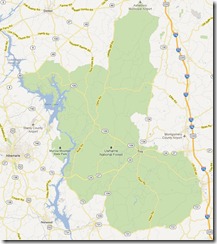
We carved a route down through the central Piedmont region of North Carolina, taking a southern route through Uwharrie National Forest on the way down and returning along the more northerly Uwharrie Scenic Byway, a little more than 300 miles round-trip.

Uwharrie is also the name of a mountain range and we were stunned at the highest crest on that route returning north and east to see a spectacular “Blue Ridge” type view of a mountain range in the direction of Durham. Uwharrie National Forest

I think it was probably the ridges of the small Cane Creek Mountain range that runs south and west from Burlington and Graham.  I kick myself for not pulling over to take a photograph but by the time it registered we were in descent.

A little known secret in state tourism promotions which are heavily weighted toward the mountains and beaches is that not only is the central Piedmont the most visited portion of North Carolina, thanks to the draw of cities such as Durham and Charlotte, but it is also incredibly scenic if you stick to state roads and especially scenic byways rather than Interstates. 

The Uwharrie is one of four national forests in North Carolina and at 51,000 acres it is the smallest.  It is an actively managed forest but it also features a primitive area in the northern portion and recreation areas.

It is also being used to reforest 100 acres of longleaf pines each year. According to the new book American Canopy, a huge arc of longleaf forests once covered 140,000 square miles stretching through nine states from southwestern Virginia to Texas, enough to cover every inch of North Carolina three times.

Beginning in the 1880s, this vast forest was “exhausted over the course of ten to twenty years” by northern capitalists.

The devastation of that period led to the establishment of forestry schools such as the first one here in North Carolina at Biltmore near Asheville.  Graduates were eventually hired by timber companies and helped usher in an era of sustainability.

The Uwharrie was purchased by the federal government during the Great Depression and made a national forest by President John F. Kennedy in 1961.  Today, longleaf reforestation already covers 800 acres in the Uwharrie.

But North Carolina’s 1.3 million acres of national forest are about much more than sustainable forestry.  Of the 7.5 million visitors to the forests each year, 48.5% go there to view scenery and 28% drive through them for pleasure, as we did last weekend, thereby adding to the renewable return on investment from these incredible  natural resources.

North Carolina’s current legislature seems bent on sacrificing the state’s natural resources, first turning the scenic roadsides over to outdoor billboard companies for clear cutting at no charge and soon for natural gas fracking.

Hopefully before it is too late North Carolina voters will intervene.

Monday, February 29, 2016

North Carolina’s Earliest Post Progressives

Following the American Revolution and creation of a new system of government, North Carolina spent the first four or five decades of the 1800s under the control of regressives.

Before delving into the small but determined resistance to regressives during that period and what they would be able to eventually change, as well as a state icon they couldn’t in time, it may be helpful to explain what regressive means.

Philosophically, regressives differ from other conservatives because rather than just seeking to tap the brakes on what they see as unbridled progressivism, regressives actually seek to reverse progress.

Following the American Revolution, most were not among the third of North Carolinians still loyal to Great Britain or, of course, the 25% in bondage.

But regressives represented a faction that lobbied for a return to those pre-war values and ideals.

In the Tar Heel state, a slightly higher percentage were regressives than than those who were characterized as radicals or rioters because they wanted even more change.

Together, these two group narrowly outnumbered the remaining loyalists, most of whom would emigrate elsewhere.

Throughout the nation, as other states perpetuated the progressivism upon which America was founded, regressives in North Carolina during those early decades earned it a reputation as the “Rip Van Winkle” state.

As a result, land values plummeted as more than a third of North Carolinians moved away.

Between 1830 and 1840 alone, nearly half of the counties lost population according to a superbly documented book entitled, North Carolina Through Four Centuries.

The 1850 census revealed that 31% of all native North Carolinians still living in the United States resided in some other state.  Backwardness had driven away more than 400,000 Tar Heels, two-thirds of whom were white.

This was equivalent to half the state’s population in that census.

For the first half of the 1800s, the legislature was controlled by less than 10% of the population, including slave-holding planters living down east who were adamantly opposed to public education, roads, government in general and taxes.

Fast forward two hundred years.  Sound slightly familiar?

Between 2000 and 2010, half of North Carolina’s counties were again losing population with most relocating to the state’s more progressive cities.

Regressivism is as much a part of America as any other view, if not a bit ironic in a nation forged by progressives.  But it doesn’t take popularity for this view to seize control.

Because very few voters today are able to vote for the handful of legislators who are in control of setting legislative agendas in many states, including North Carolina, those decisions are also essentially controlled by about 10% of the electorate.

In part, it is an inherent flaw in representative democracy vs. more “popular” forms of democracy, but not perhaps, a view currently held by regressives who often seem to rationalize overriding the views of the majority of voters by insisting that the same would be done to them were they not in power.

Fueling this partisan view of “screw them before they screw you back,” is the fact that since 1998 “fewer than 10% of both state senate and state house seats have been competitive,” a factor driven by partisan gerrymandering of districts.

The thing to remember is that during much of that earlier period of regression following the Revolution, a handful of deeply concerned and resilient North Carolinians were persistently advocating progressive ideas, which following the Civil War, would put “the state on a totally new course.”

They were named Yancey, Caldwell, Fisher, Swain, Gaston, Morehead and Graham.

But their architect was Judge Archibald DeBow Murphey who was born in Red House, which is now called Semora, a crossroads just northwest of what is now Hyco Lake, a twin in Person County just west of Mayo Lake where we now split time with our home just south in Durham.

The area of Murphey’s origins is now a part of Caswell County, but when he was born it was a part of Orange County. 

Judge Murphey eventually practiced law down in Hillsborough a few miles west from what is now Durham and established a residence in Hawsfield (southwest of current-day Mebane.)

It was during this period that Murphey crafted his plan for North Carolina’s salvation including “establishment of a public education system, construction of canals and turnpike roads, as well as a general public welfare system,” and eventually railroads.

In fact, regardless of sympathies, North Carolinians weren’t paying much attention to succession leading up to the Civil War.

Instead they were focused on constitutional reform and a struggle over ad valorem taxes as a means for wealthy plantation owners to pay their fair share to fund Murphey’s vision.

Many of Durham’s founding generation were heavily influenced by Murphey’s strategic views including his close friends here, the Camerons.

They encouraged others in what would become Durham to push for statewide progress such as building railroads and a strong banking system.

Keep in mind by 1820, only 7% of Americans lived in cities and progressives such as Murphey saw a scalable role in development and progress for state government. 

There were only 61 settlements with more than 2,500 people in the whole country at the time and only five with more than 25,000 people so progressives such as Murphey were clearly farsighted.

But progressives at the time were not able to save the longleaf pine forests that provided North Carolinians their “tar heel” nickname as well as a species of our state tree.

In pre-settlement times, these savannah-like forests dominated a swath from northeast North Carolina in a strip that straddled the fall line between the Piedmont and Coastal Plain continuing in an arc down through the south all the way to Texas, 90 million acres in all.

These would have been the forests where my 8th great grandmother Mary Jane was born on Salmon Creek, more than three hundred years before I would uncover my North Carolina roots.

But from a time before North Carolina earned its “tar heel” nickname until the mid-1800s, these trees were used for naval stores or in other words tar, pitch, rosin and turpentine.

More than just shipping, it was the “wagon” industry that relied on grease produced from these distinct trees as well as uses for their wood by settlers, such as fencing.

Colonists would gird or strangle the trees to death while replacing the understory savannah grasses with corn and other crops as well as letting livestock such as hogs range wild.

Soon huge numbers of hogs, cattle, horses, mules, sheep and goats eventually trampled through these forests contributing to their demise while depleting the soil across much of North Carolina by 1900.

By 1920, the longleaf pine was virtually extinct. 

Gone were not only trees that take 100 to 150 years to reach full size (between 98 and 115 feet) and may live to be 500 years old, but gone too were seas of understory savannah grasses.

Environmental and science historians have placed nearly as much blame on these practices for the sediments that will muddy North Carolina’s streams, rivers and lakes for a thousand years, as they do on the farming practices used to raise cotton and tobacco.

Another factor is that we know now that our soils in the South are much more fragile than other parts of the country.

Fully two-thirds of the deforestation that has taken place across America over the last 400 years occurred during the sixty years between 1850 and 1910.

When a movement took hold to re-plant pine trees in North Carolina, short-leaf pines such as loblolly were used instead of longleaf pines because they grow faster, much closer together and don’t require ground fire to reproduce.

Since the 1960s when collectively pines were named North Carolina’s state tree, efforts have been underway to re-establish longleaf pines using prescribed fire along their base as well as protecting the tiny old growth stands that have been discovered.

But one thing is for sure, for now this means that North Carolina has a much different natural sense of place than it once had.

It is in the wake of this desecration that culminated in the early 1900s that another strategic wave of progressivism took hold in North Carolina, launching its mainstream status as a tourism destination.

More on that in the next post, including a fourth wave in the early 1970s that voters embedded in the constitution, something that legislators including regressives today choose to ignore.

Monday, August 16, 2010

Recognition For Durham Wait Staff Rock Stars

In the just-out August/September issue of Durham Magazine, editor Matt Dees made a brilliant decision in recognizing several of the stalwarts of Durham’s nationally recognized foodie scene.img079

Few careers are more difficult than those in restaurants and none are more critical to the success of Durham’s celebrated restaurants than rock star wait staffs.

In an excellent article by freelance writer, author and DM contributor Emily Matchar with excellent photography by Briana Brough, I was delighted to see three people recognized with whom I’ve struck up friendships over the years.

Graham and Brad Weddington at Nana’s, just down the hill from where I live, are both friends with whom I visit several times a week. And for years now, I’ve been friends with Alison Martliew during her time at several restaurants in Durham including now both at Pop’s old and new locations.img080

One of the obvious perks of my former position as CEO of Durham’s official marketing agency, was becoming colleagues as well as good friends with many in Durham’s colony of nationally recognized chefs.

But equally pivotal to bringing Durham its foodie reputation are the many individuals and “first responders” represented by the folks in this excellent article.

Kudos to Durham Magazine, now in its third year, and publisher Dan Shannon who previously founded Chapel Hill Magazine. Tough to launch in a downturn but it is a testament to Dan’s commitment and determination.

Like most “city” magazines, Durham Magazine, as noted on its website, is very narrowly cast every other month, to 15,000 upscale households and businesses. Subscriptions and sales through selected newsstands and grocery stories bring the total bi-monthly distribution to 40,000. Hopefully, in time, it will be much more broadly distributed.

I receive mine at home through paid subscription.

Wednesday, January 07, 2015

Yellowstone As Metaphor

Because I am representative of both sides, I am eager to read a book due to be released this summer entitled, The Battle for Yellowstone: Morality and the Sacred Roots of Environmental Conflict.

It is a study of old west belief systems such as those held by my great grandparents, grandparents and parents who forged ancestral ranchland where I was born along the Idaho edge of Yellowstone.

It also concerns the overlapping “new west” concern for protecting and restoring habitat and wildlife.

But while the data is both quantitative and qualitative, Yellowstone is used as a spiritual metaphor for how Americans approach moral disputes overall.

My Idaho roots stretch back to territorial days a dozen years before the creation of Yellowstone as America’s first national park, straddled a few decades later, when my my ancestors who began settling the Rockies in 1847, forged the horse and cattle ranch of my youth along the park’s western border.

By the time I came along the Bowmans had pushed large populations of Grizzlies back into the park and equally proximate Targhee National Forest, almost eliminating wolves and subduing the resulting over populations of beaver. 

But ranchers back then had an innate grasp of ecological balance, and most were early conservationists, if not considered early environmentalists.  Today those camps have become tribes who see the other as enemies.

In my experience, the battle there is not between old west and new west but sterilized, extremist versions of each who refuse to listen to one another.

In other words a microcosm of what’s gone wrong with America.

In a quote in The Economist recently, Dr. Jeff Hardin a devout Christian and zoologist at the University of Wisconsin-Madison put it succinctly while noting that “Many partisans subscribe to the post-Enlightenment idea that giving people lots of facts ought to be enough to convince people.”

Guilty as charged.

But today and maybe always according to Hardin, “most of us hold our beliefs in a tangled ball of yarn.”  “Tug on one thread, and people fear that their very identity is under attack.”

I don’t have much patience for some of today’s ranchers who see the rebalancing of populations of wolves, Grizzlies and bison as surrogate agents of the federal government.

But environmentalists can also fail to accept or inform opinions with new information, such as this report in High Country News, revealing that reintroduction of wolves is not a panacea in Yellowstone and that some ecosystems once altered may never recover.

Last month, a jury in my native Fremont County, Idaho convicted a hunter of illegally killing a Grizzly bear and it reminded me that in the 1840s when most of my ancestors settled in the Rockies, the historic population outside of Alaska of 50,000 Grizzlies between the Pacific coast and the Mississippi River had already been pushed back into what are now the plains states.

Settlements back then required hunters such as my great (x3) grandfather Thomas Graham to protect against Grizzlies.

He was killed by one in November 1864 while protecting another ancestor and livestock in Northern Utah about 28 miles from the Idaho border.

But until recently, the last known Grizzly in Utah were seen in 1923, the year my father was born.  Today, they no longer exist in six western states, including California the “Golden Bear” state, where they had been driven out by 1922.

By the time I was graduating from BYU in 1972, only a few hundred were in existence with a concentration in and around Yellowstone including Targhee National Forest near our ranch.

There were several hundred verified sightings in our nook of Idaho between 1965 and 2000.  Male Yellowstone Grizzlies can range more than 300 square miles, far more widely than other populations.

Between 1974 and 1979 when I was marketing Spokane, scientists tracked Grizzlies in and around my native nook of Idaho along the border of Yellowstone to document clashes with livestock such as cattle and sheep.

It was a lot less than ranchers believed but it only takes one encounter to inflame fears.  The truth is that raising livestock on rangeland is inherently risky for many reasons and predators such as wolves and Grizzlies are easy scapegoats as is the fear of disease from bison.

But thanks to endangered species protection, Grizzlies in and around Yellowstone are now back to a sustainable high of 700 or more Grizzlies.  Nor do they stay put, ranging five times the distance our ranch was from Yellowstone.

It may be time for delisting and based on the recent conviction turning the species over to state management, at least in Idaho where a management plan has long been in place.

In my native Fremont County nook of Idaho, ranchers, farmers, conservationists, settlements and sportsmen also have a proven track record of reaching compromises to protect the famed Henry’s Fork River, from which Grizzlies scoop up their share of native Yellowstone Cutthroat Trout.

But environmentalists are distrustful, giving too much credibility to the relatively small group of vocal ranchers who refuse to accept the importance of ecological balance or even sit down to listen even if to agree to disagree.

There are solutions but just as with the innovations of the Affordable Care Act, they come from admitting that some parts of alternative views are with merit, while acknowledging that something one might have disagreed with is actually working.

Our way out of gridlock is to put those with extreme either/or views on the sidelines and to return to the practical middle ground that is part of what made this country so exceptional.

Tuesday, January 13, 2015

In Search of Boots

A quarter of a century ago, I was recruited from my native west to Durham, North Carolina, where I still live in retirement.  Unlike today, back then there wasn’t a place for a native westerner to provision cowboy boots or a good Stetson.

But a new acquaintance told me of a place thirty miles west which had been frequented a year or so earlier by actors and film-makers producing the movie Bull Durham here.

Off I went early one Saturday morning in a venerable Porsche 911 to find Tom Baily’s Pony Express.

The postal service, which long ago began to purposely ignore the importance of aligning delivery addresses with actual physical locations, took me the long way in the days before GPS.

The store isn’t in Graham, but I’ll bet that is where the carrier picks up the mail for delivery.

It is actually located on NC Route 87, a third of the way down to Pittsboro about a half mile above the Cedar Cliff cut-off and only three miles from Saxapahaw, which it seems would have been a more accurate postal designation.

Not even 50 years old when we met that day, Tom Bailey and I found a lot in common including his handcrafting of custom saddles and American Quarter Horses.  I became a frequent visitor.

A month or two before I retired five years ago, a friend and I stopped there to replace some boots and to show Tom, my new Harley Cross Bones and were stunned to learn he had passed away a few weeks earlier.

He was just the age I am now now.

The store is still there but it isn’t the only connection between the western wear of my native Yellowstone-Teton nook of Idaho where I ended four generations of ranchers going back to territorial days.

If you cut 38 miles southwest through Snow Camp and then up the highway to Greensboro, you arrive at VF Jeanswear, the headquarters of Wrangler jeans.

But it didn’t start out that way.00523_p_10aeuyf6sw0647_b

Wranglers came along the year before I was born but in 1904 the company started in Greensboro as Hudson Overall Company, about the time my great grandparents and post-frontier grandfather were homesteading ranches along the Henry’s Fork River.

Note their dress in the 1907 photograph shown in this essay.

Westerners didn't begin wearing jeans and cowboy hats until the 1870s and even later along the western slopes of the Rockies, shortly after after they adopted cowboy boots.

This was many decades after my ancestors began to settle the west and about the time westerners gradually began to dress like tourists from the east expected them to, based on Wild West shows and Dime Novels.

Before then, they wore wool pants in the winter and canvas pants in the summer with possibly a variation of wellingtons and bowler and/or slouch hats.

Western snap shirts didn’t come along until 1940 or so, a few years before bolo ties became common.

In my part of Idaho, bolo it is pronounced more like “BOWla.”

By the time I came along, my grandfather always dressed in a Stetson, khaki pants and khaki shirt buttoned to the top but like my dad had after returning from WWII, boots patterned more after those worn by GIs during the war.

My dad, by then, had also shifted to wearing ball caps, a habit picked up in the army and to my horror, overalls, like he had worn as a kid  such as the predecessors of Wranglers and sometimes overalls.

During my early years, 50s TV westerns such as Hopalong Cassidy, Gene Autry, The Lone Ranger, Sky King, Roy Rogers and Death Valley Days were the arbiters of what ranchers were meant to wear.

I still prefer Wranglers, slim fit boot cut.  Jeans aren’t what they used to be. Even Levis seem paper thin.  But looking back on western wear, it may be that it never was what it used to be.

One thing is for sure, just as it is today from Greensboro, near where I live, western wear originates as much from the south and east, while the west, as it has always been is exploited and despoiled by easterners and their enablers for natural resources.

But I miss Tom.

Monday, February 25, 2013

A City Creek Walk Through Time

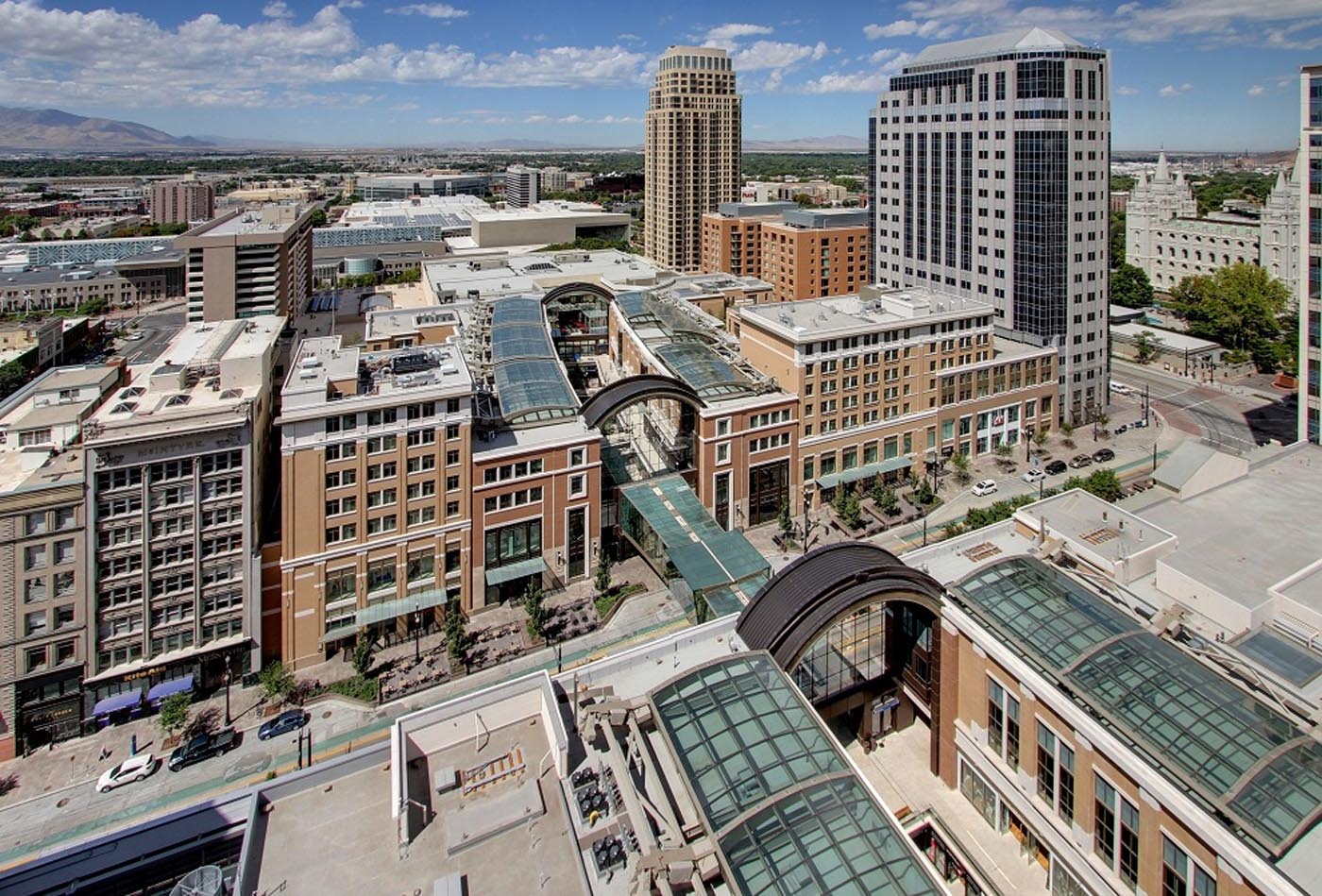
My earlier than expected arrival last month in Salt Lake City gave me a couple of hours to explore my personal connection with the recently-opened, spectacular 23-acre City Creek Center in Downtown Salt Lake City, after parking in one of the 6,000 underground parking spaces.

It was nearly 166 years ago that two of my great-great-grandfathers and one of my great-great-great-grandfathers first rode down from a canyon in the Wasatch Range toward a small grove of Cottonwood trees along what would be called City Creek, the Center’s name-sake.

They traveled ahead of a vanguard company of 148 Mormons who were the first to arrive in that valley in late July 1847 following an 1,100 mile journey up and across the Continental Divide.

They pulled up a block or so south of where the new Center is located now and hurriedly constructed dwellings and planted crops in advance of winter, after first softening the earth by temporarily damming City Creek across its six mile journey from a canyon to the Jordan River.

That winter two of my ancestors, Charles and his 15-year-old son Andrew, also found time to build a “ship” as a way to earn funds.  Among that small number, they also encountered a thief who confessed to stealing some seed corn from them during his trial and was given “five lashes on the bare back.”

By 1849, this branch of my ancestors was assigned property in the original 13th Ward, directly across the street to the east of where City Creek Center is now, near where a spectacular Harmon’s has opened in conjunction with the massive development and my great-great-great-grandfather Charles had been appointed Deputy Marshall.

In those early years, Mormon leaders had decided all property would be public-held with stewardship assigned to various families.

There, my then-17-year-old great-great grandfather, A.P. Shumway, busily herded cattle along the creek and built adobes.  He and others also dug ditches to carry water from City Creek past each individual plot to be used for drinking and irrigation.

Today, this location is at the base of an office tower where coincidentally, my daughter and A.P.’s great-great-great-granddaughter works as assistant corporate counsel.

And as City Creek flows out of a canyon on its way to entombment beneath Downtown Salt Lake, it passes near where my grandsons attend an innovative school where learning through music is a balance to their passion for sports.

As I explored the spectacular City Creek Center last month, parts of which are both inside and outside, the temperature hovered in the low teens, held there by several days of inversion above Salt Lake Valley. Breathing air that cold for the first time since leaving Alaska in late 1980s brought back a flood of other memories.

The real City Creek remained the lifeblood of Salt Lake City throughout the remainder of the 1800s.  As the city’s population surpassed 92,000 in 1909, the creek was entombed.  This was the same year that my great-great-grandfather passed away near the town of Franklin in my native Idaho.

The nearly quarter of mile creek of that name that flows through City Creek Center today is a man-made facsimile, much like a similar water feature of approximately the same length dubbed Old Bull River that flows through the restored 16-acre Lucky Strike factory complex in a downtown district of similarly-sized Durham, North Carolina, where I live.

The real spring-fed City Creek famously resurfaced in a 1983 flood when suddenly swollen by a spring thaw it day-lighted once again and flowed during a brief reminder down the surface streets that traced the original path of its south fork.  Entombed once again, efforts to daylight City Creek once and for all continue.

A.P. Shumway left Salt Lake with his father later in 1849.  They were “called” by Mormon leaders to lead a party of 100 families south 135 miles to settle the pastoral San Pete Valley after a request by Ute tribal chiefs.  The valley is the geographic center of what would become Utah Territory a year later and a state in 1896.

However, I suspect, that for them, Salt Lake was already becoming too crowded.  Wagon trains of more than 1,000 people each had begun arriving, followed by ‘49ers who stopped for the winter on the way to the gold fields of California.

Andrew’s father Charles was described by his in-laws as someone of “hardy stock” who “loved wild country.” Even with so few settlers having arrived in Utah in the late 1840s, various aspects of human behavior were manifest.

Cattle will not paw away snow to eat like horses will which is why ranches such as the one where I spent my early years used large horse-drawn sleds to distribute bales of hay during winter snow.

In the winter of 1849, some of the 100 families elected to remain by camp fires deeming it the will of God if their cattle died due to an unusually heavy snowfall while my ancestors went out each day to shovel clearings in the grass so their cattle would not starve.

The Shumways also formed another settlement further north and were caught up in hostilities with Native Americans known as the Walker War with my great-great-grandfather, then 21, fighting at Salt Creek before settlers were ordered to temporarily evacuate.  He assigned blame for the war to those who failed to obey instructions from church leaders to live peacefully and respectfully along side Native Americans.

My great-great-great-grandfather Shumway then bought a farm about four miles from where another of my great-great-grandfathers, Charles Harper, had settled in Holladay.  In 1856, my great-great grandfather Shumway returned east to visit family in Massachusetts after an absence of 18 years and passing through several slave-holding states.

I can imagine that talk of abolition and secession made him wonder if the Union, into which Utah had been annexed after the war with Mexico, would survive its new division into Republicans and Democrats who were subdividing during the Presidential election during his visit into Southern and Northern factions.

In December of that year he sailed aboard the paddlewheel steamship Arabia to Liverpool, England before being called back to Utah within months through New York aboard the packet ship Underwriter when federal troops under Colonel and soon-to-be Confederate General Albert Sidney Johnston were ordered into Utah to depose Mormon officials in a bloodless coup known as the Utah War.

Soon, A.P. married Amanda Graham, the granddaughter of a Revolutionary War veteran from North Carolina who had settled in Alabama.

Both Shumways resumed colonizing, settling Cache Valley where my grandparents were born and later Arizona.  I wondered if I inherited any of their toughness as I hiked up an incredibly steep San Francisco-type hill at the end of my walk last month to rendezvous with family.

Looking back at City Creek Center,  I remembered that shortly after I graduated from Brigham Young University in the 1970s, the Mormon Church had invested $40 million to help revitalize Downtown Salt Lake an effort which included two malls.

Now its for-profit real estate arm has invested approximately $1.5 billion in City Creek Center to replace them with a new combination of retail, residential and office, none of it from tithing and part of a $5 billion revitalization.

I wondered what my three ancestors in that 1847 vanguard company would think now and how compelled I feel to leave information like this for my descendants.

Monday, April 18, 2016

The Unlikely Origin of Tourism’s Sense of Authenticity

Reaching back to a tent restaurant erected there in 1919, Lexington brands itself, at least in part, the “barbecue capital” of North Carolina, a state with considerable heritage in that regard.

But it was a tragic train accident eight years earlier that occurred between that would-be tent site and what is now High Rock Lake that is more symbolic for tourism historically across the nation.

My Tar Heel Roots go back to 1650 but because I am the last of a line of five generations of Idaho ranchers going back to the 1860s and didn’t make my way to North Carolina until 1989, I’m considered “adopted” by those who could be considered far more relative “newbies.”

But it seems that wherever I’ve lived, including my native Yellowstone-Teton nook of Idaho, I’ve crossed paths with William F. Cody.  It was least expected here in North Carolina as I began what would be the last half of a four decade career in community destination marketing.

When a freight train tragically smashed into one of three trains near Lexington, Cody’s “Buffalo Bill Wild West Show”s (sometimes known by other names) was in the midst of 40 performances throughout North Carolina between 1878 and 1916, including two in Durham where we live.

Over 100 horses were killed in the accident, and the vitality of the show that had also performed hundreds of times throughout the country and throughout Europe would never really recover.

But it is easily arguable that no other person did more to instill a curiosity for transcontinental travel across the United States in both Americans and those overseas.

His attention to detail and authenticity informed expectations. 

Equally significant, Cody redefined and instilled a deep appreciation for history, culture and artifacts among those living in relatively newly settled lands east of the Hundredth Meridian.

He seemed to innately grasp what place branding expert Bill Baker tries to impart wherever he is invited to teach.

The brand of a particular place is, in essence, its innate personality.  It exists at the intersection of what internal audiences and external audiences perceive it to be.

Today, more than ever, it is not something you conjure up or create, it’s simple who and what you genuinely are, something Cody understood was far more appealing than fantasy.

In a moment I will share a story or two about how Cody’s influence has helped shape the negotiation of authenticity over the decades about what it is and isn’t western, a negotiation still underway.

But first, for anyone unfamiliar or in need of a very quick refresher:

Cody was born in Iowa in 1846; the year after my ancestors began fleeing across the southern half of that soon-to-be state toward sanctuary in the Rockies.

Then his family moved to eastern Kansas where he lost his father.

At age 11 he worked as a rider carrying messages between drivers and workers on wagon trains before becoming a bullwhacker, then a trapper, miner and briefly a Pony Express Rider.

He enlisted in the Union Cavalry and after the war worked as a buffalo hunter for the railroad.  Cody then became a Chief of Scouts for the 5th U.S. Cavalry, leading the rescue of Wild Bill Hickok.

Eventually, he earned the Medal of Honor during the Indian Wars.

Cody became a public figure and the subject of dime novels as well as outspoken about the rights of Native Americans.  In addition, he became a performer and show producer.

As a close friend of President Theodore Roosevelt, Cody was also instrumental in the nation’s first national forest and the national reclamation act.

The best way to get a sense of William F. Cody is to visit his namesake along the Absaroka Mountains in northern Wyoming as they give way to the Bighorn.

Cody, Wyoming is the eastern and to many the most scenic and least touristy gateway to Yellowstone Park.  It is also home to the Buffalo Bill Center of the West, which is comprised of four museums including one devoted to Bill Cody’s story as well as a research library.

The little town is also home to the still operating Irma Hotel which Cody co-founded a year after that train wreck back in North Carolina. 

He began by acquiring and then expanding the T E Ranch up the more secluded South Fork from Cody in 1895 and then built a hunting lodge up on the North Fork where the road now leads to Yellowstone since the dam was built.

But Cody first saw the potential of this area in 1870 while leading a scientific expedition up the Bighorn.  It happened to be the same year an expedition was being led to examine the potential of Yellowstone.

Until then, exploration of river valleys along the Rockies such as the Henry’s Fork where my ancestors would settle were dismissive of any settlement potential.  But fresh eyes such as Cody’s changed all of that.

William F. Cody had a sense of authenticity that has inspired 150 years of nomenclature about the old West and is preserved today in details and artifacts such as clothing and dress and speech.

His shows inspired audiences to travel and to know what to expect.  They also helped negotiate what experts call the ongoing interplay and socially-agreed upon construct that we designate as authentic.

Tourism faces much courser fault lines than just authenticity today.  Take for instance, the one that exists between commercial hucksterism and genuine sense of place.

The West does too, and not just recently with standoffs by a few militants in Nevada and Oregon.

In 1939, a movement anchored in the Sheridan Rotary Club began with a threat to secede and break off northern Wyoming including Cody and Yellowstone into the State of Absoroka.

The frustration back then, as it had been during the “range wars” 50 years earlier was more about intrastate politics with the federal policies as a surrogate.

But as it does today, another fault line separated the views of preservationist northwestern and fossil-fuel driven northeastern Wyoming.

I thought of this on a cross country trip through my homeland a few years ago while listening to a story on the radio far more reflective of the West in which I grew up.

A rancher down on the South Fork, near Cody’s T E ranch, was out irrigating his hay fields in June of 2013 when he accidentally came between a Grizzly and her cubs.

Watch this very short video of this remarkable account and listen carefully to Nic Patrick’s remarks at the end.

If you are a regular reader, you may recall that my great-great-great grandfather, Thomas B. Graham, was killed in 1864 by a Grizzly in Cache Valley, Utah under similar circumstances, after having put his rifle down to help my great-great grandfather load some wood.

Like many ranchers, Patrick is a conservationist.  Also like many ranchers, he has another occupation.  For nearly forty years, he and his family have built authentic log homes, often for people who are drawn to live a version of the life Bill Cody depicted.

He understands something that William F. Cody came to understand during his lifetime.

Tourism can help preserve nature and the things it loves.  But unmanaged tourism can also often introduce changes that can kill the very the things it loves.

A lot is written today about gentrification of historic neighborhoods.  If well-managed so that socio-economic diversity is preserved, it isn’t a problem.  If not, the very soul of those neighborhoods and the reasons they became so popular is rapidly hollowed out.

However, gentrification can also occur in areas of the West around public lands.   Studies show that for both kinds of gentrification, tourism popularity can provide warning signals to policy makers that they need to instill protections.

Unfortunately, tourism circles today have far too few Buffalo Bill Cody’s.  Instead of being willing to debate the broader issues society faces, they are prone instead to circle the wagons.