Thursday, November 06, 2014

An Anthem of Resilience and Renewal

Outbound on my most recent cross country trip as I drove northeast out of Fort Worth early one morning in late July on US Route 287, I was thinking of the day before when I had passed just below Gilmer, Texas where Don Henley of The Eagles was born.

Very coincidentally, while searching satellite radio channels I came across the Diane Rehm Show just as she began a fascinating interview with singer Linda Ronstadt.

Her eloquent description of what it feels like at the onset of Parkinson’s is worth it alone to listen to her interview with Ms. Rehm.

It was as backup musicians for Ronstadt that Henley and three other founding members of The Eagles: Glenn Fry, Randy Meisner and Bernie Leadon, met in 1971 while overlapping for one concert on a tour of college campuses that summer.

That fall they all appeared on a Ronstadt album, three tracks of which were recorded live at the TroubadourIt was released just as I started my last semester before graduating from BYU in 1972 while crashing at a professor’s house during a time of personal turmoil.

Country Rock, as it would be called, was calling me back to my roots at this time of personal turmoil and pain, beginning a few months earlier with Tammy Wynette’s version of Kris Kristopherson’s Help Me Through The Night and David Crosby’s plaintive Almost Cut My Hair on CSN&Y’s Déjà Vu album the year before.

But it was something about Ronstadt’s versions of Johnny Cash’s I Still Miss Someone with its crying fiddle and a cover of Patsy Cline’s I Fall To Pieces that helped me realize that it was the sound of Sneaky Pete Kleinow’s steel pedal guitar that was calling me back to my roots.

However, it is only in hindsight that epiphanies are that abrupt.

It all came together for me when I heard Emmylou Harris and Gram Parsons sing In My Hour Of Darkness, co-written and recorded the summer before as my daughter was born.

My all-time favorite by Harris is Boulder to Birmingham written and recorded the following year while in “the throes of deep grief and shock” from Parson’s tragic death from an overdose.  For me, it would soon become a hymn for redemption.

"I would rock my soul in the bosom of Abraham/I would hold my life in his saving grace/I would walk all the way from Boulder to Birmingham/If I thought I could see, I could see your face."

It was that summer, with my baby girl lying on my chest while I listened on headphones after working third shift in an aluminum mill that I first listened carefully to Ronstadt’s new cover of Desperado, co-written by The Eagles’ Henley and Fry along with So Far Away by Carole King and James Taylor.

Ronstadt’s version of Desperado is Henley’s favorite and became the signature for much of my life.

Possibly sensed through my chest where she lay sleeping, those two songs have always resonated for my daughter and me through many years apart.

The queen of hearts has always been [our] best friend.”

In 1975, as I took the helm of the first of three community marketing agencies I would lead during my now concluded career, I heard a song by The Eagles written and sung by Meisner called Take It To The Limit.

It is a song I often used over the years to call upon the resilience needed to face the rigors of each new day.

Perhaps, in part, it was the waltz tempo reminiscent of first learning to dance while standing on the feet of my parents, two of the most incredibly resilient people I would ever meet.

Henley and Fry helped Meisner finish the song he had conceived and started but it is Meisner’s unique voice that made it the band’s fan-favorite.

He is from Scotts Bluff, on the edge of western Nebraska, a point of convergence for several different routes Mugs and I take back home on these cross-country odysseys, seven since I retired five years ago.

Randy Meisner was more mature at the time than the other members of the band.  His fingerprints had already been on the very seminal influences of country rock including back up to Rick Nelson in the Stone Canyon Band.

From age nine through Junior High, Ricky Nelson’s meld of pop and country including spots on his parents Ozzie and Harriet TV show served as a bridge of musical influences for me as well as for my first kiss at a party in a friend’s darkened basement.

Meisner already had a family when he helped start The Eagles and he missed them while away at recording sessions and on long tours.  Not only was the song one of the band’s signature hits, but Meisner was called upon to hit those incredibly high notes as an encore at each performance.

By 1977 he was sick with stomach ulcers and flu and resigned from the band at its height after a confrontation because he didn’t think he could hit the notes one night.

He went back home to his family while The Eagles were at their height of popularity.

A few months later the band fell apart after releasing the prophetic I Can’t Tell You Why, co—written and sung by Timothy Schmit who, because of his similar voice, had replaced Meisner.

I saw the band in reunion when it played in Greensboro 14 years after the break-up.  The volume masked the harmonies and subtleties of the group, perhaps now impossible to replicate.

Fry did an admirable imitation of Meisner on Take It To The Limit, but it just wasn’t the same.

It marked the end of an era, a sound that still resonates today.  Needless to say, the soundtrack for our cross-country venture this year was listening to The Eagles.

It wasn’t until I watched a documentary of the band on Netflix last weekend that I realized that Meisner wrote Take It To The Limit as inspiration for just how I used it during my career.

It a timeless anthem of renewal.

So put me on a highway - And show me a sign - And take it to the limit one more time.”

Wednesday, November 05, 2014

The Underlying Fallacy of More and More, Bigger and Bigger

It should have been no surprise to, at least, tourism marketers when airlines serving Brazil attributed a drop in revenues due to the World Cup.

The paradox of mega-sports events is that they displace more economic impact than they create.  A classic illustration of that is when an economist measured tax revenue collected in a community that hosted the Super Bowl.

It varied little from collections over that same period the year before and the year after.  How can this be when input-output measures taken computed value-added?

The answer is displacement and it’s why sustainable community marketing is not about more and more or bigger and bigger but how to feather sports groups or conventions or festivals in a way that doesn’t create displacement or increased public services or inconvenience.

It is also the little known secret to why communities that carefully do this, outperform or perform equal in the proportion of visitors they draw for those segments compared to those that go “big game hunting.”

Economic impact models struggle to measure the economic activity that huge events override or dislocate such as the economic activities people would have been doing anyway or those they didn’t or couldn’t or chose not to do because of the event.

It is possible, but they would be costly to run.

If fact, if these analyses went beyond just the local or even metro or state levels, the events may turn out to have a negative impact when taking into account their impact on a national, continental or even hemispheric level.

Sure, there is value added from people who bought snacks and beverages to throw home parties for friends to watch on television or from people who went to sports bars or drank more or stayed longer who wouldn’t have otherwise or who traveled to see the event in person.

But that amount would need to also net out the activity these consumers would have generated anyway had then been out shopping or buying vehicles or attending performances or taking trips they postponed to avoid perceived crowds or to watch the event on television instead.

Ironically, the net effect of mega-events can be negative overall.

Does that mean mega-events are bad?  Nope.  Just that communities and nations shouldn’t be deluded by those who use economic impact as a rationale for hosting the events.

It is also why visitor-centric economic development organizations such as those I ran over a four decade career can, if data and results-driven, be frustrating to stakeholders who don’t understand their purpose or who make up their minds and then take interest only in information to support their opinions.

Such organizations, called community, state or national destination marketing organizations are often given only one of two choices by powerbrokers.

Just go along to get along while withholding critical information from the public or get steamrolled and disparaged including as one official threatened me once misusing a metaphor, being forced to “fall on your own petard.”

People aren’t rational by nature, especially fanatics, but the role of a community destination marketing organization, while it involves bringing popularity to a particular place, isn’t to be popular but instead, rational.

Many years ago, I had a chair of my governing board who worried about my personal welfare, dismissed the high regard for our organization and me personally in scientific residents polls or anonymous opinion polls of community stakeholders.

His was overly concerned with the opinions of a trio of people who wanted my head and seemingly hated the community marketing organization  I led and therefore lobbied whoever would listen to undermine us.

So I spent an inordinate amount of time and energy meeting with these individuals in an attempt to better understand where they were coming from, even hiring a consultant who was an insider in their circle to coach me.

They were nice enough in person but what got under their skin was simple.  We made decisions based on data, not who’s asking.  When the data didn’t make our case we were as likely to distribute to inform community decisions as we were when it did.

My job though, was to continue to try in every way possible to show even detractors how they could also achieve their objective using data and sustainable tourism.

I was lucky to have governing boards who stood behind me as long as we were following the data, resisting special interests and doing what was best for the community overall.

It is also why I have empathy for former peers who weren’t so fortunate and who, instead, were forced to surrender their community’s welfare to powerful forces, a slippery slope from where there can be no return.  “But for the grace of God, go I.”

In one community, a cabal of five people collectively came after me, ostensibly over my “style” which has definitely always been a work in progress.  I survived there on a 10-7 vote, a veritable landslide in political terms.

In my two other communities, similar votes under even heavier-handed circumstances, though less publicized, were far more favorable, a testament more to my heart than style.

But that’s all part of the job.  Politics is personal, not logical, but in community marketing you can never make it the former.

The job of community destination marketing is to reap a community’s full share of visitor-centric economic and cultural development.  That requires four things not generally understood as part of marketing:

  • Strategically deciding what not to do;
  • Disqualifying events, groups and segments of potential visitors that don’t fit or cost more than they can deliver;
  • Pursuing visitation in scale that will complement and appreciate things distinct to a particular place; and
  • Seeking to do no harm to the things that make a community worthy of love.

In summary, without surrendering to more and more, bigger and bigger, the organizations I led were able to statistically outperform or keep pace with those that did, even if it didn’t make the news or appease special interests.

Tuesday, November 04, 2014

The 1975 Predecessor Who Grasped Sustainable Tourism

To complete a startup is how I refer to the second stop in my community destination marketing career, five years after getting one off the ground in Spokane.

In June of 1978, I got a call from Allen A. Reeves who had received my name from several experienced DMO execs as someone he should recruit as a candidate on behalf of the governing board of the one in Anchorage.

I wasn’t consciously looking for a change, nor had Anchorage or Alaska been in my frame of reference but I had heard of Allen.  When I had come on board in Spokane, Allen Reeves was just completing a six year stint as the exec for the Las Vegas DMO.

During that span beginning in 1967 was a turning point for Las Vegas.  It was smaller at the time than either Spokane or Anchorage and just a bit larger than Durham, a single-city county where I would later finish my career.

But in 1966, Caesars Palace had opened in Las Vegas signaling the end of a more authentic era and foretelling a complete surrender to fantasy.  I suspect he had sensed by 1970 that destination marketing there would never again be about community but a chain-link of thematic escapes from reality.

We know now from research conducted by companies that cater to fantasy that a proportion of travelers many times greater is drawn to places that are real.

His next stop, six weeks after I began my career in Spokane, was Hawaii, where he arrived just as a perfect storm was brewing over its sense of place.

We never talked about it.  Allen had a remarkable mesmerizing gift of gab and his mind leapt so quickly that a two-way conversation often became impractical.

But you can tell from his interviews that deep down he understood sustainable tourism.  At the time, Hawaii was in a struggle to save its sense of place and, from Las Vegas, Allen knew how quickly that tipping point could occur.

Tourism promotion there had begun in 1902 but it was only in 1945 with the conclusion of WWII that destination marketing was officially established.  Visitation to Hawaii reached 50,000 by 1949, the year after I was born.

It collapsed the following year due to a maritime strike and the state became a partner in its revival, establishing what may have been the first million dollar tourism marketing budgets.

Tourism really took off there with statehood in 1959, not only because of the notoriety and sense of intrigue that helped fuel it, but because commercial jet service began that year.

By the early 1960s that DMO also went after conventions, a type of travel where the destination is only a backdrop but a key factor in site selection.  Between 1970 and 1973 convention attendees had doubled to 139,000 with overall visitation reaching over 2 million.

But not everyone was unhappy.  Residents, always the most important stakeholders, hated the explosion of non-descript - if not ugly hotels - that refused to fit into sense of place like the old resorts did.

Visitors were arriving without reservations and the DMO was scurrying with Operation Aloha to get residents to take them in.  They were also coming at times that overwhelmed public services.

Surveys of convention delegates also lamented the loss of the “there-there,” and tourists from the American mainland griped about the increasing numbers from Japan.

The chair of the DMO’s governing board publically called for controls on hotel development through careful zoning and while two-thirds of residents still saw tourism as an asset, only 38% felt they benefited.

Like a freight train, it takes a long time for destination marketing to get up to full speed and it is hell trying to put on the brakes by pulling back on promotional materials already in distribution, but the DMO Hawaii did its best to tap them.

Allen was very articulate at the time about going after visitors, especially conventions, only during periods and in volumes where they wouldn’t put a burden on the environment, public services or sense of place,

He was very forward thinking at the time.

He argued that while there were 740,000 offsite meetings held throughout the country in 1972, 68% of them were most desirable because they required 200 hotel rooms or less and could selectively be recruited to fit into time periods where they were unobtrusive and made sense.

It is a lesson that other DMO execs even today failed to heed, pushing for mega-events and mega-facilities that displace more economic impact than they generate and run up deficits for taxpayers.

It is also why, taking heed to that way of thinking, destinations such as Durham today outperform those that don’t in both visitation overall indexed to capacity but also the proportion attending conventions.img117

Allen left Hawaii in July 1975 to help get a DMO off the ground for Anchorage, Alaska, a community and state where sense of place was and still is very fragile.

At the beginning of that year, the then-City of Anchorage had enacted a room tax on the rate paid by guests in hotels, motels and bed and breakfast (cities and towns have home-rule in Alaska.)

That spring, the visitor sector had scurried to put together the framework of a DMO in the months before the City of Anchorage, three other towns and the Borough of Anchorage unified into the Municipality of Anchorage.

They requested and received a grant of $100,000 from the City of Anchorage, enough to recruit Allen and in July he cobbled together another $25,000 from the Greater Anchorage Borough (a version of a county.)

During that fall, while Allen was raising another $20,000 from private sources, the unification of local governments into the Municipality of Anchorage took place in September incorporating the room tax into its new charter.

The Greater Anchorage Convention/Visitors Bureau commenced marketing (mostly sales) on October 1, 1975, soon dropping the “greater” in light of unification a few weeks earlier.

Allen quickly put a face on community marketing for the mission of visitor-centric economic development and cultural development and hired a small staff to get things rolling.  It is their logo in the image above, which was in use until we created “Wild About Anchorage.”

Before he had arrived, the governing board had established by-laws and a few policies.  For the fiscal 1976-1977 year, ACVB marshaled a planned budget of $210,000, hoping to persuade the by-then Municipality to increase its investment from the room tax from $125,000 to $180,000.

From my time bootstrapping the DMO in Spokane over that same period, I know what a herculean task that was.

By 1977, Anchorage generated 586,000 visitors spending $167 million, 4% of which was from convention and meetings, when Allen announced he would be returning to Hawaii to be closer to his wife’s large extended family.

With the new fiscal year beginning in July of 1978, I replaced him as CEO of ACVB and three years to the day from when he had arrived in Alaska, Allen headed back to Hawaii as a vice president for Inter-Island Resorts, in an attempt to salvage Hawaii’s most venerable tourism company.

I saw him a few times there but lost track of him after the company dissolved in the mid-1980s, although the once-five star resorts continued on.

But it was the end of an era.  Inter-Island had fingerprints on historic steamship lines, inter-island airlines and much of what had become Hawaii tourism.

In 1978, over 90% of the conventions held in the United States could fit in Anchorage but much of it was held during periods that would either displace other visitors or during seasons where we still needed to develop activities and attractions.

But my first job was to work out sustainable self-funding for the organization that could scale up from the $319,000 budget available that first year.

To make our case, I met with George Sullivan, the long-time mayor both before and after unification, who would later serve on our government board.  He remained a good friend after leaving office.

George agreed that more of the room tax would be well invested in community marketing but explained that the Assembly had already committed it elsewhere, foretelling the dilemma I would also face in my next post, Durham.

I proposed increasing it and he agreed on one condition and he agreed but insisted it would have to be voter approved so elected officials couldn’t later try to divert it.

We went to work on that and in late 1979, the voters approved the increase to the room tax and dedicated it to ACVB marketing, a testament in good part to the face Allen had put on the effort initially and because voters innately understood both the fairness and the benefit.

The tax was paid by visitors and if used to attract more as well as improve circulation and satisfaction, the results would be many times what was spent on marketing that could then be used to provide residential services.

Inscrutable is why so many elected officials struggle with that logic, continually looking for ways around it instead or pressing for ways to siphon it off, validating by their seeming avarice a negative feedback loop regarding taxes in general.

By the time I, too, would leave Alaska ten years later, after first spending a year as the founding and interim-CEO of the Anchorage Economic Development Corporation on behalf of Tony Knowles, a subsequent mayor, friend and eventual governor, a lot had changed.

But Alaska never truly leaves you.

I continued to hear from Anchorage friends and officials right up until I retired more than two decades later and still do in retirement, including recently Mary Pignalberi, one of Allen’s first hires.

On my watch and on the foundation Allen had created, ACVB had pushed visitation to more than a million annually, and more significantly, had shifted the off-season to summer visitor ratio from 1:10 to 1:1.

This included increasing convention spending from $7 million annually to $40 million, with 50% regional or national in scope, somehow exceeding market share for a national comp set while being selective for fit and having to overcome the obstacle of distances that were 1,500 to 3,400 miles greater even by air.

Behind the scenes, ACVB had pushed against past powerful forces within the state and beyond to make Anchorage a viable year round alternative for segments of visitors that had never before considered the state while leveraging its unique sense of place.

Anchorage’s “unique selling proposition” at the time (something it could uniquely guarantee) was “if you don’t have the time or money to see all of Alaska, you can see and experience representations of every part, during every season, in Anchorage.”

Unfortunately, we invariably also made a few enemies along the way, as Allen had, but for me truer measures of sentiment were that membership support had increased from 40 businesses when he left to more than 1,000.

Resident approval of ACVB’s efforts had also reached an unparalleled 30-to-1 positive to negative ratio.

Sustainable resources for marketing had been increased from $350,000 to $2.5 million, all self-funded through increased taxes paid by visitors.

Still, as there always are, a few naysayers complained that we were either not doing enough (for them, specifically) or were stepping on some toes, which we had, not intentionally, but in the intensity to secure Anchorage its due.

As George Sullivan, a mentor, friend and life-long Alaskan who had served as mayor there for 14 years and who in 2009 would pass away just three months before I would retire from DMO work, wrote to me as I was leaving Anchorage:

“After putting one’s heart, soul, sweat and tears into an organization for these many years, your leaving is like leaving a good part of your life behind you.”

Next year ACVB celebrates its 40th anniversary and Anchorage’s 100th.  I had not yet turned 30 when I arrived there and was just turning 40 when I left, leaving destination marketing there in far more capable hands over the decades, none more so than today.

Allen had been a little older than me, on the far side of a divide that was opening in destination marketing as we met and which I had been fortunate to step across during my five years in Spokane.

But to me, he holds a pivotal and far more nuanced role in laying those first cornerstones at the foundation of ACVB’s success.  Along with those who hired him and those who have served at the heart of its organizational culture all these years, hats off.

I leave this background from my personal papers to both to honor them and as a way to compensate for any shortcomings I had in archiving during my stint during the DMO startup there.

Friday, October 31, 2014

Preceding Fingerprints On The Official Record

My narrative as a former community marketing exec began with the 1976 DMO startup in Spokane, Washington, one of three I helped shape during my four-decade career.

But “origin” stories never begin that abruptly, and to leave the impression they do is an injustice to those who left earlier finger prints.

That first opportunity started when I answered a 1973 job listing in the newspaper placed by a retired Shell Oil exec a week or two before my daughter and only child was born there and two months before I would enroll at Gonzaga School of Law.

So I could attend classes at night, I needed a full-time job during the day and my new boss needed someone who could call everyone in a huge, dusty library-type card catalogue to see if the people there were still alive and willing to bring a convention to Spokane.

At 56, Don Dagman had taken early retirement from Shell in 1971 and taken a job in response to a study the year before by Economic Research Associates.

Seven years older than my father, we were “Mutt and Jeff” when it came to the cultural divides at the time.  I wore my hair long, opposed the Viet Nam War and anticipated, based on new revelations by John Dean, how Watergate would play out.

Don was a company man who never questioned authority.

He was a baritone-voiced, deep-chested descendent of Swedish immigrant farmers who, “out on the edge of the prairie,” migrated up the western edge of eastern North Dakota’s Red River where he was born.

As a twenty-year-old he ventured to the Pacific Northwest and began his self-taught career with Shell in Portland, Oregon.  But Spokane was his home and remained so until he died at age 90, just a handful of years before I would conclude my career in community marketing.

That consultant’s report on behalf of the Spokane Centennial Commission was entitled the "Plan and Feasibility of Proposed Spokane Ecology Exposition,” and it called for formation of what is today called a community destination marketing organization to leverage follow-up.

Dagman, whose more than thirty year career had basically been public relations for Shell, was drawn to my resume because I had been involved from 1970-1972 in startup of a campus destination marketing effort while completing an undergraduate degree at BYU.

But for a little less than two years before he hired me, he had already been setting expectations in the news media, giving visitor-centric economic development a face there and making up for any lack of background or expertise in community marketing with hutzpah and bon vivant.

We made a good team.  I brought a knowledge of startup intensity and ramping up an organization from scratch, a penchant for data analytics and as an omnivert, just enough extroversion to be a good sales person.

I learned by watching Don Dagman the importance of earned media, also known as publicity, as a more powerful, more credible and far more cost effective part of marketing than advertising.

Looking back, this was also part way through an incredible “sense of place” span that began in 1965 with passage of the Highway Beautification Act, followed in 1966 with the creation of the National Historic Registry.

Then came the clean air and water act, which validated the importance of nature, followed by renewed interest in recycling waste and Spokane’s 1974 environmental World’s Fair.

Concerns about heritage, rootlessness and the unintended consequences of so-called urban renewal reached a tipping point during the 1976 American Bicentennial, followed by the 1978 landmark decision by the U.S. Supreme Court validating preservation of place as a government goal.

This twenty-year span culminated in the early 1980s with an essay by Wallace Stegner who anointed the overarching term “sense of place.”

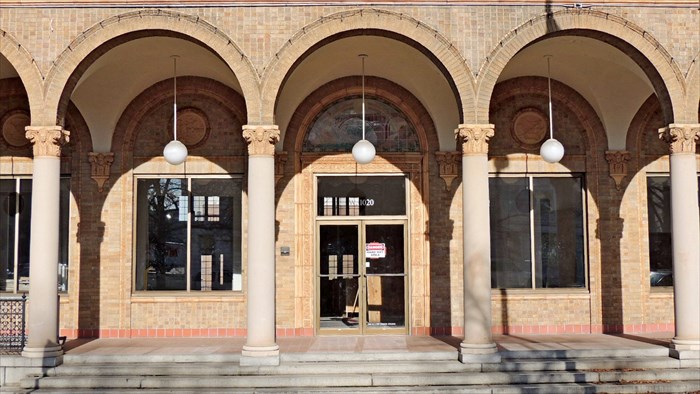
Our offices during that two year transition, while embedded in the chamber of commerce, were in the 1930 Civic Building with spectacular views from our offices along a back wall down a deep gorge at the base of the Spokane Falls.

In front, this capstone “second renaissance revival” building, a sub-style of Beaux Arts had wonderful archways and a terra cotta roof.

Taken together with others it formed a sweeping contiguous arc of historic buildings begun in 1902 and identified a few years later by the Olmsted brothers as part of a grand square, war memorial statuary and all.

As we worked away inside, a successful nomination was being readied for creation of this area as the Riverside Avenue Historic District including a cathedral, a Carnegie library and a series of social and community buildings.

In a lower level one day, Don, always the consummate promoter in search of publicity, emptied out refuse collected by housekeepers from wastebaskets in a handful of local hotels during four days of a convention I had booked.

He had us sort the wrappers we found from 50 different stores and then invited a newspaper reporter to view them as an example of induced and indirect economic impact.

This was decades before the far more scientific input-output model, pioneered just the year before, would become a feasible alternative for visitor-centric economic development metrics at the level.

Neither Don Dagman nor I realized that a little more than two years after we teamed up, I would change career paths and be appointed to lead the transformation to Spokane’s stand-alone community marketing organization, when he was ensnared in a controversy.

But Don and I also happened to bridge another generational divide that Spokane stills struggles to cross today.

At the time, community marketing was transitioning from a minimized role primarily in response to erection of edifices in need of traffic such as convention centers to more holistically role viewed as the means to fuel overall visitor demand by leveraging sense of place and making all amenities, if market driven, feasible and sustainable.

I moved on a little more than three years after being named its exec first to Anchorage for a decade, to complete a startup just begun, then another from scratch in Durham where I worked for more than two decades before retiring.

But Spokane, despite the evidence of far broader visitor appeal during Expo ‘74, has in many ways remained at least partially trapped on the far side of that community marketing divide, as far too many communities have.

I not only read carefully that 1970 ERA report from which so many others merely quoted from the summary, but I rescued a series of old 1930s and 1940s newsletters along with some community brochures dating to 1907 that were being thrown out one day.

They showed that Spokane back then had seized on the idea of community marketing only two decades after the first spearhead had been formed, even participating in the See America First cooperative.

Those documents also permitted me to piece together metrics from those much earlier roots for community promotion that had somehow been long forgotten,

This including evidence of a publicity and news effort dating to when motor vehicle tourism first took root and convention metrics reported decades before those in the ERA report.

For example, by 1942 Spokane was hosting press tours and cranking out news releases and distributing photographs to 200 publications across the country.

City-wide, it was estimated that Spokane hosted 172 visitor-related conventions attended by 34,000 delegates spending $750,000 that year.

By 1947, convention attendance had increased to 37,000 delegates spending $1 million but Spokane was looking more holistically at overall visitor spending of $9.5 million.

But spending by just the fraction of visitors attending conventions had peaked in the early 1960s at $6 million annually and declined by 1970 to $4.2 million, along with any consciousness of visitors overall, when experts advised that a community marketing agency be created.

But no one had connected the dots of that decline to when Spokane had suddenly stopped promoting the community, something I was able to verify by those old index cards I was asked to sort through in 1973.

I also took time to verify convention-visitor impact.  Instead of beginning to climb again to the more than $6 million as Don had been led to report for 1971 when he was hired, by 1972, the year before I was brought on board, it had continued to fall to $3.5 million.

Through community marketing including harvesting exposure created by Expo ‘74, that impact had been nearly tripled to $10 million, all without a convention center.

By the time I left in 1978, we had pushed it to $17 million dwarfing the $1.8 million harvested by having a convention center, an adaptive reuse of one of the pavilions also recommended in that 1970 study.

But my eyes had been opened to the far greater potential of marketing holistically to visitors overall rather than limiting focus to conventions.

Projections of visitor spending overall for 1974 had been only $9.6 million but the 5.4 million to attended the six-month Expo ‘74 had generated $90 million in spending from visitors alone and studies showed that by leveraging overall sense of place including the new Riverfront Park it would generate even more going forward.

But In the early to mid 1970s, consultants were typically brought in to justify public facilities as real estate anchors to shore up private property values or as a barrier against advancing blight.

If they knew, they failed to explain to communities that facilities such as hotels and convention centers aren’t demand-generators but activity-centers created by harvesting visitor demand generated by marketing the community as a whole.

Failure to connect these dots until 1997 led to a quadrupling of convention center space across the nation over a period when conventions and meetings tipped into decline and the vast majority of events began to opt instead for meeting space in hotels.

But this hindsight wasn’t available with the 1970 report, which estimated that conversion of one of the World’s Fair buildings into a convention center by 1975 would result in an additional $1.8 million in convention visitor spending that year alone.

That turned out to be only 18% of what would be generated by aggressive community marketing alone and two-hundredths of one percent of overall visitor impact.

Today, Spokane generates $870 million from visitors annually (not counting closer in daytrip visitors.)  This includes the 28% generated from delegates attending conventions, a ratio inflated ten percentage points by the fact that Spokane has no major nearby population centers from which to draw leisure visitors.

But attendance at events using the Convention center has been flat to slightly down since 1999 with only a third counting as value added to the Spokane economy, about the same ratio of overall conventions as it represented in 1975 before two expansions.

While failing to look at market share or weighted proportions nationwide or warnings by other consultants beginning in 1997, many still use the same dated formulas from more than four decades ago to recommend expansion as a solution.

This fails to account that today convention centers compete not with other convention centers but with space within hotels in the same community, often giving them a net negative impact.

Nor do they take into account that this is a mature market in gradual decline or that groups broken down by size are getting smaller and smaller.

Though consultants never dispute one another, a far more strategic consultant report notes, just as that 1970 study did, that it is scenic beauty, outdoor recreation and a lively downtown that give Spokane its appeal and far greater overall visitor potential.

Just one of many communities with factions that continue to push aside “best practices” and data-driven decision-making to argue instead for “worst practices,” Spokane is extremely blessed to have a skilled data analyst who blogs there anonymously.

If he is looking down, Don with that characteristic twinkle in his eye, would probably give a wink, knowing that Spokane is still struggling to cross over that community marketing divide one of us leaped four decades ago.

He would also agree that while I may have been a startup/organizational innovator, it was always on the shoulders of those whose finger prints I found there stretching back decades.

I dedicate this background to making sure Don’s never fade away.

Thursday, October 30, 2014

Putting A Fiscal Value On Roadside Character

Deep in the appendices of a study scientists conducted along the nation’s roadsides in 2010 is an estimate of how many acres of forestland is along roadsides in North Carolina’s portion of the National Highway System.

Not counting roadsides along forested state highways or all of the rural roads it maintains in each of the state’s 100 counties, just the 28% of the NHS portion still with roadside trees alone means the North Carolina Department of Transportation is in the forest preservation business.

Or it should be.

This is 7% of all state and local government forestland.  I suspect it is would be closer to 30% if an inventory were conducted of roadsides along all NCDOT-maintained roadways.

And that is just the point.  NCDOT has no boots-on-the-ground inventory of this asset, nor a strategic management plan of caring for this publicly-owned commons.

This is why there is typically no reality-based fiscal note provided when legislators vote to surrender this public asset free to out-of-state billboard companies, including no requirement to reforest taxpayer trees when destroyed merely for a few more seconds of face time.

It is also why there can be no cost compared to benefit when contractors with mechanized assets push to remove thousands of acres of trees unwarranted by federal maintenance guidelines.

NCOOT regulators know that merely using the miniscule value as “pulp” has long-ago been antiquated as forest service scientists over several decades have meticulously documented the far greater value of the trees to ecosystem services such as reducing harmful emissions.

Long ago state officials were given a heads up to scores of other types of valuations including the role of roadside forests as the signature asset both for tourism, a sector now adding an incredible $10 billion to the state’s GDP including its appeal to scouts for relocating or expanding businesses.

It wouldn’t be expensive for NCDOT to conduct a tree inventory using just the 200 randomly selected plots of 1/10th acre each required by i-Tree Eco technology created for this purpose by forestry researchers.

Plots selected by random would include ones in various regions of the state and population intensities as well as terrain and vegetation cover, including areas with no trees areas as well as views worthy of scenic preservation and those where blight is screened.DSC01342

Outputs would also provide a baseline for the number, age and health of trees along the roadsides including the percentage of each species and overall management needs.

It would also quantify the overall value calibrated top local climates and other variables.  Officials need only contact Dr. David Nowak, the research forester who created the process and who patiently broke it down for me during a phone conversation last year.

Here is an example done of street trees by the Virginia Tech Department of Forest Resources using i-Tree, but NCDOT might be able to add to its considerable resume for best practices by being the first agency of its type to conduct such a roadside assessment statewide.

It took the feds nearly a decade to sign agreements for implementation with all fifty states after the Highway Beautification Act was signed on October 22, 1965, a herculean effort by the agency that today rarely even lifts a finger to enforce it.

North Carolina officials like to claim that forestland acreage here today is about the same overall as was in the 1930s.

But that disguises the fact that it had been much higher when it peaked in 1964 as the HBA was being debated in Congress. Since then, forestland has also declined precipitously (p. 4) in North Carolina.

It has also declined dramatically since 1971 when business leaders helped encouraged voters here to pass an amendment to the State constitution in part meant to protect forestland such as that along public roadsides (Sec. 5, Article XIV.)

Emblematic instead, is that those sworn to uphold it simply don’t, with newly enabled sacrifices of forests along roadsides and soon interchanges, which is pushed only by lobbyists today on behalf of parasitic commercial billboards.

But following the embedding of that amendment in 1972, state officials let another million acres of public forestland disappear, prompting cities such as Durham in 1984 to enact billboard bans in self-defense, followed by protective scenic overlays along new Interstates and in 1999, ordinances to protect tree canopy in general.

Yet, here too, local officials have failed to follow up with an inventory of this signature symbol of sense of place, a powerful prerequisite of any strategic management of green infrastructure while “billboarders” and their legislative allies press to override three decades of local effort to be more appealing.

While more than 8-in-10 North Carolinians - and an even greater proportion of visitors - are reverential about forested North Carolina roadsides, they are easy to take for granted.

Much of what we see today has grown back in the last 50 years.  As the HBA was passed, there had come to be a billboard every 1500 feet nationwide along highways (imagine seeing one every city block.)

By 1984, enforcement of the HBA had removed barely half a million billboards and prevented another 200,000 but billboard companies had used loopholes, campaign donations and graft to continue to litter cities alone across America with half a million billboards.

Durham, North Carolina had had enough and enacted a Republican-led ban that year while many other communities in North Carolina and across the state succumbed to heavy-handed lobbying, graft and threats instead.

However, after the very highest courts sided with Durham, the state sided with the billboard lobbyists.

Today, the feds look the other way when it comes to enforcing the Highway Beautification Act enabling billboard companies to push through phony rezoning.

It isn’t enough that North Carolina has once again permitted enough billboards to be put up along U.S. highways here alone to be the equivalent of one per city block, but a legislative give-away recently enabled them to triple the cut zone forgoing a million or more  publicly owned trees.

And yet, there is no inventory of the forests the public owns along roadsides or any holistic estimate of the value of roadside forests’ worth, including tourism, although according to public opinion polls, they are priceless to Tar Heels.

In the meantime, as any use of billboards by consumers to buy something had fallen now to “two-tenths of one percent,” lobbyists are readying a push with legislative allies to force communities, even with those with bans to permit digital billboards.

Sound like reasonable stewardship to you?  Or maybe it is time for a moratorium to preserve North Carolina’s scenic character, while it still has some left!