Monday, March 30, 2015

Anecdotal Madness

I held this post back for a few days so it wouldn’t appear to be rubbing salt into places where pride was so freshly wounded.  But this post is about more than just the Final Four or college basketball.

Sports reporters, especially in North Carolina where so many learned the basics in journalism at UNC-Chapel Hill, often repeat a myth that just has never held up to scientific scrutiny.

It found its way into several stories written last night after Duke became the fourth finalist: that Duke is the basketball team people love to hate.

It was so pronounced, that beginning in the early 1990s, Durham’s newly established community marketing organization used it as inspiration for one of a handful of markers as it set out to pin down and resolve misinformation undermining the community’s image.

Repeatedly over the years, polls showed that Duke’s highly successful men’s basketball program was not only the most popular in Durham, but a very close second in UNC’s home county.
Coincidentally, at the same time a national poll by Harris found that Duke was America’s favorite men’s basketball team, a position it has held now for 12 of the last 18 years including 2015.

In the six years when it was not America’s favorite, it was 2nd most favorite five of those years, falling to third one year, 1997.

The University of North Carolina was most favored three of those years giving the metro area centered around Durham and Chapel Hill a very unique status.  UNC has averaged just below #3 while Duke has averaged #1.

Kentucky has averaged just a bit more popular than UNC, possibly leading to a Kentucky-Duke culmination of this year’s Final Four dominating brackets across the country.

But what about here in the state of North Carolina?

I watched newcomers to Durham from Michigan stop by a table of Duke football players having breakfast this weekend to josh that Duke would be their new fav when a man nearby jumped from his chair, interrupting a phone call and a mouthful to scream, “no in North Carolina, it is the Tar Heels.”

However, he wasn’t joshing.

Walking away, the newcomers were puzzled and other patrons just looked down.  He may have been right about football, but probably not for long.

But what do metrics show regarding basketball?

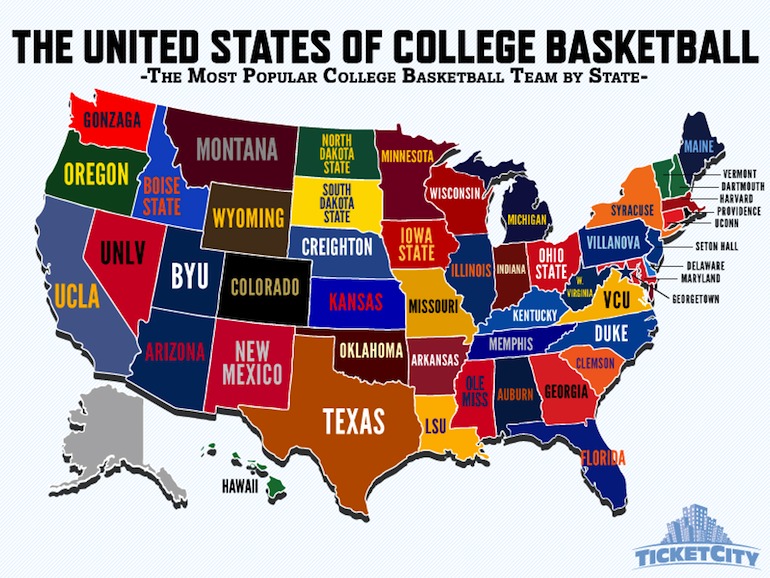
TicketCity, an agency founded in 1990 by a University of Texas grad took a look at which teams scored highest for engagement in their own state, factoring game attendance, Google search and social media over the past year.

Here Duke came out #1 too, in the North Carolina.  BYU was tops for Utah and Gonzaga for Washington, giving me an added alumnus trifecta.

All of this does not negate that Duke might also be hated, which is a different metric altogether, just that it would be irrelevant without showing it in the context of overwhelming popularity.

Sports reporters are emblematic of the challenges that face news reporters overall.  Drawing anecdotes as evidence of a more generalizabe public opinion is very tricky.

Local news in Durham has inferred that its recent population growth is due to the turnaround of downtown Durham in the last few years.  But Durham was the fastest growing city in North Carolina throughout the 1990s when its downtown had yet to emerge and its image underwent a turnaround.

How could this be?  Because Durham’s self-image and its image nationwide has always been high.  Over the 1990s is when negativity about Durham entrenched in surrounding counties was gradually reversed.

For sure, the image turnaround by 1999 lowered one of the barriers key to downtown revitalization by opening the minds of the news media, realtors, developers, financiers, as well as newcomers.

But downtown revitalization was also spurred both here and across the nation after the year 2000, not just by favorable shifts in psychographic and demographics but even more so by the innovation that year of New Market Tax Credits (NMTC.)

NMTC’s were recognized by Harvard in 2009 as one of the nation’s most innovative government programs leading to this 2010 case study of their dramatic success in downtown Durham.

Studies, scientific polls and generalizable metrics may not be as exciting as hyperbolic anecdotes for news reports or news consumers more interested in the pursuit of legends and myths, including their own.

But these tools are crucial to any community seeking a factual basis upon which to truly shift perceptions and initiate change.  Studies, polls and metrics are also important when assessing which coattails to ride or credit.

There is no institution more deserving of credit for everything Durham has achieved than Duke, and no program there more deserving of enhancing Durham’s reputation than Coach K’s Blue Devils.

Friday, March 27, 2015

How To Truly Help Rural Counties

The State of North Carolina pours millions of dollars more per capita into into the state’s 85 rural counties yet still half of the state’s 100 counties have lost population since 2010.

Those rural counties that haven’t lost population usually owe it to being within the commute zones to metro areas such as Durham where non-resident commuters hold down 2 out of every 3 jobs.

Not only do commuters not help shoulder their share of the costs for quality of life and sense of place amenities that make work-side communities such as Durham so appealing to job creators, those that create sprawl push the costs off onto others.

In other states, commuters often pay a very small payroll tax to compensate the cities to which they commute, but instead, North Carolina continues to make residents of urban areas subsidize those from rural counties.

For instance, the special transit taxes levied to relieve the congestion commuters create is levied not on the counties where they choose to live, but on the residents in urban counties who already choose to live closer to their jobs.

Go figure!

Now a few state legislators want instead, to further worsen that inequity by letting commuters and daytrip visitors from rural counties take home any sales tax revenues they generate work-side or there as tourists for purposes other than work or school.

These examples show a fundamental lack of understanding of the basics of economic development and the unintended consequences of other wealth transfers when the state builds or improves roads to and from rural counties that are not warranted by traffic.

Economists and others who measure economic impact and generation separate economic development into supply-side and demand-side.  Ribbon-cutting officials usually focus on supply-side such as paying incentives for businesses to relocate or expand.

Demand-siders such as those familiar with visitor-centric economic development know that this is the surest and purest way to generate economic development and impact.

A decade ago, many of us coalescing around statewide tourism issues suggested that the state tourism development be refocused on rural counties including the development of capacity there to draw tourism from the state’s urban areas.

This dawned on some of us when it was revealed that 80% of the state’s tourism related tax revenues are generated by the state’s urban areas.

This impact was generated when counties were given the option of shouldering special taxes on visitors to self-fund visitor promotion that is collectively many times greater than that budged by the state.

Some of us proposed that the state should refocus its entire tourism promotion budget in support of rural counties including helping them promote instate visitation from urban areas.

Tourism in rural areas appears to be a “chicken and egg” dilemma, but it really isn’t.  It doesn’t begin with recruiting hotels, which don’t create visitor demand, but are built to serve it.

Tourism begins in rural area with “retained tourism.”  This is when a rural area takes a full inventory of its assets and locally-grown businesses, features and events and works to encourage residents there buy and experience local.

State tourism officials could then begin to shape those local assets into tourism identities by conducting marketing designed to encourage residents of urban area to experience these rural areas on day-trips.

They won’t have to encourage me.  I love riding our Harley Cross Bones through rural North Carolina and nothing more than discovering a local restaurants or store there.

As the volume of day-trippers grows to these areas, residents will develop bed and breakfast inns and as promotion of the assets in these communities fills those rooms, other types of commercial lodging will take an interest.

Existing and new home-grown stores, restaurants, features and events, bolstered by “retained tourism” from residents as well as daytrip and then overnight visitors, will gradually expand capacity and become more sustainable.

This is also the best way to draw the attention of entrepreneurs seeking to start new businesses or executives seeking to relocate or expand because more than 80% visit areas as tourists before announcing their search.

The formula works, but it takes patience and learning to appreciate those things that make each rural area distinct.  It also requires that the state help to protect these areas from blight such as billboards and teaching that traditional advertising is no longer an effective marketing strategy, particularly on a small budget.

Residents of urban areas, such as me, love North Carolina’s rural character, especially when it is safeguarded from blight.

We want its rural character to be sustainable and to thrive but not through the misguided examples of those urban areas which have fallen for “built it and they will come” supply-side ruse only to sell out their sense of place and soul to mainstream interests.

This, tragically, will make them indistinct and unworthy of love and eventually visitation.

Helping rural areas makes sense, but it won’t be achieved as some in the legislature are trying to do now by pitting rural areas against urban areas as well deconstructing urban areas by redistributing even more wealth and permitting special interests such as billboards to once again defile them.

Instead, state policy makers should incentivize rural areas to learn from the mistakes of many urban areas including the failure to index population growth to developable land while factoring in the value of forest, open space, historic scenic preservation.

Maybe a good start is for the course elected officials take to include an understanding of demand-side economic development.

Thursday, March 26, 2015

The Price for Being Quiet

I could smell Spring as it sprung a few days ago.  It is an early morning smell I recall from my job as a morning delivery paper boy fifty six years ago.

It is the quietness I also remember from my youth.  This map of the quietest and noisiest places across the contiguous United States shows that my native Yellowstone-Teton nook of Idaho is still very quiet.

In fact, it is amazing how quiet the West is compared to the Midwest, Northeast and South, as shown on the map in this blog.  I’ve been intrigued since first spotting it in a blog posted last month on Discover and now in High Country News.

Durham, North Carolina where I have now lived for 39% of my life --longer than any other place -- is relatively noisy, but you wouldn’t know it on our early morning walks down through a city park and then up the steep slopes of what we affectionately call Mt. Rockwood.

About a mile and half from downtown Durham, Mt. Rockwood is a ridgeline that appears to be the highest elevation between Chapel Hill and the even higher Red Mountain in northern Durham.  Where I live now is not only noisier, it is also 4,789 feet lower than the ancestral ranch where I was born.

Durham County is the 17th smallest land area in North Carolina but created for a city of the same name that is now the fourth largest in population.  It has been the epicenter now for two different manifestations of the New South.

Initially, proponents lobbied to name it Mangum County in honor of a Willie P. Mangum, a U.S. Senator from here who had stood firm against hardliners in the state legislature, in favor of a national compromise regarding slavery.

In his day, it was Democrats who had been the regressives in control.

Durham was selected as the name making it synchronous for the city for which it was created, the only place in the state where a county and city by the same name are both found in one location.

While much of the state was overrun by marauding gangs of the KKK, Durham had emerged after the Civil War as a center for the progressive South and an accepting sanctuary for people fleeing the violence in rural areas.

In the 1950s, northern Durham spawned another U.S. Senator William Umstead, this time elected as governor of North Carolina who before he died in office set in motion the development of Research Triangle Park here.

Building on a long history here for innovation, RTP marked Durham’s emergence as the center for creativity it is today, and a magnet for talent and relocating businesses and corporations from around the world.

Today, another wave of regressives, Republicans this time, are devoted to dragging Durham in reverse along with other urban areas by pitting rural against urban as a metaphor for when those of this mindset in another political party, pitted white against black.

Regressives also tried this approach in the 1920s, pitting rural against urban, rolling back voting rights and openly being hostile to women and immigrants.

Public opinion polls show that only about 18% of Americans today think this way but is it coincidence this is also the percentage of Americans who deny climate change and worry “not at all” about the environment?

They sure make a lot of noise.

Probably also not a coincidence, this happens to be the same percentage of the American workforce in general as well as in North Carolina specifically, shown to be “actively disengaged,” meaning they are:

“employees not just unhappy at work; these employees undermine the accomplishments of their engaged coworkers.”

Maybe a quick follow up or cross-tab would confirm that all of this noise comes from the same 18% of Americans.

Protected by clever redistricting, those in elected office here are doing everything possible to deconstruct cities such as Durham by overriding popular ordinances to curb blight such as billboards as well as design guidelines to protect neighborhood property values and sense of place.

Now they have their sights on tourism, also known as visitor-centric economic and cultural development. Cities such as Durham work hard to be appealing including to the millions of North Carolinians who visit here annually on daytrips.

The purpose is twofold: fuel the local business climate and expand the local tax base, something the state’s largest cities forget when they provide subsidies to draw events in excess of the tax revenues they will generate.

People live in rural areas instead for many reasons, the quiet, being closer to nature but also to avoid paying taxes for services urban dwellers seek.

Now regressive want to redistribute the wealth cities generate by letting rural North Carolinians “have their cake and eat it too” - enjoy the benefits of trips into cities without helping to provide for that environment and then take their sales taxes back home.

So how does 18% of a population pull down the other 82%?  Clever redistricting for sure.  And a lot of voters who fail to hold their elected officials accountable for harm they do to others including fostering warfare between lifestyles.

But even more enabling are other elected officials who fall for clever introductions written for bills but fail to read for legislative intent and consequences, settling instead for horse trades.

In the end, tyranny and regression in this country never work for long.  But it always takes decades to repair the damage.

We need a little more noise in North Carolina.

Wednesday, March 25, 2015

Thoughts From A Roadside

Several thoughts raced through my mind yesterday while viewing the roadside of a freeway interchange in Durham, North Carolina, where I live.

These parcels are very park-like when well-maintained, as members of a public-private coalition called Durham Appearance Advocacy Group (DAAG) is trying to do by forging alliances between local governments, businesses and groups such as garden clubs and Scenic North Carolina.

The one we discussed yesterday is meant to serve as a template for every interchange in Durham.

But ironically, regressives in the State Legislature have been working at odds, filing bills to disable state management of these roadsides and permitting out-of-state billboard companies to wantonly deforest them in order to prop up an obsolete technology few Americans use now.

Now they have even filed a bill, with an innocuous misleading intro, meant to override wildly popular democratically enacted bans on this form of desecration marketing and blight that have stood in communities such as Durham for more than three decades and ruled constitutional by the U.S. Supreme Court.

This tyranny by representatives not from Durham reminds me that revolutionaries founded our democracy not in opposition to taxes but due to corporate loopholes granted by the feudal systems of governance then in place.

In opposition at the time and ever since stood regressives trying to pull the country backwards.  One wonders, will another revolution soon be sparked?

In the 1930s, roadsides such as those I was standing alongside yesterday were already battlegrounds between the forces of blight and the forces of scenic preservations.  Jobs, jobs, jobs was the mantra then too but it was both/and when it came to scenic preservation.

Highway 100 was one of the first, if not the very first beltlines in the country.  It patched together a series of existing roads south and west of Minneapolis but included new construction of a stretch of more than 12 miles including what we now call clover leafs.

It was deemed the “Lilac Drive,” lined with 30,000 plants including 8,000 Lilac shrubs and 7 roadside parks.  It became a recreational destination and living proof that Americans are drawn to scenic character over commercial blight along their roadsides.

It was in the middle of nowhere back then but had the support of development interests and billboard companies eagerly pushing for sprawling suburbs that would soon gobble up acreage at a rate many times the rate of population growth, as it still does today in Durham.

Emily Badger reported in The Washington Post this week about a new study that that concludes that sprawl costs the U.S. economy now more than $1 trillion a year.

The reason deficit hawks are not licking their chops is that $400 billion of this is pushed off on other people, something economists call negative externalities, which is a fancy word to describe when the free market doesn’t incorporate its true costs.

Only a portion is found in inflated costs for public services.  We absorb the rest sometimes in our lungs and often while stuck in traffic, but all in all it is very similar to the tax loophole that led to the original Boston Tea Party.

Billboarders and their legislative allies aren’t the only ones who want to shift even more of those costs onto unsuspecting Tar Heels including millions of us “hard-working taxpayers” we so often hear regressives talk about.

Over the last five decades (1960s-2000s,) the NCDOT has carefully reforested and afforested more than 5 million trees along the state’s roadsides, in part, to mitigate for many times that number which had been destroyed during road constructions.

The trees were also meant to bolster a signature ingredient of North Carolina’s brand.

This included lining the state’s roadways with spectacular understory trees such as native Redbuds and Dogwoods, the state tree.  Then, without thinking, another unit enabled private maintenance contractors to destroy most of them just for their convenience.

During our cross-country road-trip a few months ago for my mom’s funeral, Mugs and I took I-64 through Saint Louis.  This included a 10 to 11 mile stretch through the heart of that area that had recently been rehabilitated.

Some even call it that community’s front door.

The area is sea of concrete and buildings leaving almost no roadside.  But the Missouri DOT has carefully carved tiny slivers of planting areas where possible along this stretch and recruited businesses and organizations as landscape sponsors.

It too, I suspect is meant as a pilot project for a more strategic approach going forward.  An example of the discreet but very visible signs erected for sponsors is shown as the image in this blog.

Research shows that less than a fraction of 1% of consumers still use billboards.  It takes less than six seconds to decipher one but consumers only give them an average of three, even when digitally flashing on and off intermittently to draw attention away from the road.

Yet billboard companies now want to deforest even interchanges in hopes that someone traveling past them or focused on exiting or merging onto the highway will have twice as long to look.

Yes, it is obscene and possibly the spark for another revolution, if not with torches, pitchforks or midnight rides, a roadside revolt.

Tuesday, March 24, 2015

Looking Out 35 Years From Now

Frankly, I was always a bit puzzled, back in the day, to hear myself introduced as innovative or strategic.  I still am whenever I guest lecture college students, including many who are pursuing my former career.

On reflection, I have probably always been more of a “repurposer.”  Studies show that less than 14% of Americans are strategically inclined. 

However, according to experts who study strengths, inclinations such as this, otherwise known as talents, are “naturally occurring patterns of thought, feeling and behavior.”  They are building blocks that can be refined and amplified through education and skill development.

For the rest of us, talents such as being strategic don’t come as naturally but we can still develop a certain level through practice and study.

Studies show that learning to see things strategically is also the secret to why some people can juggle multiple priorities making it is just as relevant to working through a daily list of assignments.

My first brush with thinking strategically probably began in 1970 when a history professor recommended that I read a newly published book entitled, Future Shock.

A quote that has stuck with me through the years is, “The illiterate of the future will not be the person who cannot read.  It will be the person who doesn’t know how to learn.”

But it is the co-author’s second book entitled, The Third Wave which I refer to students today who are serious about learning to think strategically, more than 35 years after I read it for the first time.

It isn’t just because so many of the possibilities the authors concluded have come or are coming to pass today.  It is because it is written to show how they arrived at those conclusions by understanding the patterns of the past.

For instance, the book foretold the “collapse of consensus” we are experiencing today but it also sheds light on where we might go from here.

The revolutionaries who founded this country revolted against the feudal systems of governance then in place.

Societal headlines today reflect those who want to move forward to a more sustainable path and those who are trying to pull us back into another era or at the very least keep one foot in the past.

By looking at past patterns, the authors of The Third Wave, Alvin and Heidi Toffler, were also able to predict the change in how we will view being employed or unemployed in a world with more and more people but fewer and fewer jobs.

A blog I enjoy reading is Carolina Demography.  A recent post noted that of the nearly 4.5 million North Carolinians (age 16 and older,) 3.3 million or nearly three-quarters are of prime working age (25-64.)

That definition is slightly more broad than the norm.

Experts who have suggested that unemployment analysis would be much more relevant if it focused on the prime working age population, generally use ages 25 to 54 for this cohort.

A poll published three months ago by the Kaiser Family Foundation with the New York Times and CBS found that a little more than half of the U.S. population age 18 and older falls in the prime working age.

About 18% are prime working age but unemployed.  This group includes 26% homemakers but able to work outside the home, 34% disabled and unable to work and 24% unemployed and able to work.

Of the 24% who are unemployed but able to work, 5% don’t want a job now or in the future, 8% will want a job in the future, leaving 19% who want a part-time job and 67% who want a full-time job.

When this group is asked which factors are a major or minor reason they aren’t working, 52% cite family responsibilities, 32% cite health problems (although they are not disabled,) 38% note lack of education or skills, and 34% say their job was replaced by technology.

Other factors listed are 32% jobs because jobs are going overseas, 28% because of discrimination and 35% apparently don’t need the income.

Of the 78% who are unemployed, able to work, and have looked in the last year, 86% are open to entry-level in another field, 81% are willing to return to school or job training, 77% are open to non-traditional hours, 64 would take minimum wage, 45% would move to another city, 46% would commute more than hour each way, 69% would take 10% less than the last job and 37% would take 25% less.

There are some smart people across the full length of the ideological spectrum who are noodling about what we do as it becomes more and more a privilege to have a job.

One is called a universal basic income that would replace the myriad of safety net programs and a better option for the 25% of all workers including 40% of those in restaurants or food service who need public assistance on top of what they earn.

Ben Schiller makes a good argument that this is also a better way to eliminate poverty.

People who dismiss the ability to look ahead any more than three years if that, including many serving on governing and elected boards, as well as far too many executives are well advised to read or reread The Third Wave, but for process rather than content.

The exercise may be not only be inspiration to look back for clues to the possibilities lying beyond the horizon – perhaps another 35 years.